Agency operations
How to get content from clients without chasing them every month
The photos never arrive on time because asking for them is harder than it looks. Here is how to make sending you assets the easiest thing in your client's week.
On this page
The calendar is built, the captions are written, the slots are booked. What is missing is the photography the client promised three weeks ago, and the only lever you have is another polite email.
This is the single most common reason agency social slips. It is worth treating as a process problem rather than a client problem, because the process is usually at fault.
Why the assets do not arrive
Think about what you are actually asking. Your client has to remember an abstract request, decide what counts as a good photo, find the files on a phone or a camera, work out how to send something too large to email, and do it before a date they did not set. Then they have to do it again next month.
Compare that with every other request they get in a day. Yours loses.
The usual workarounds make it worse. A shared Drive folder requires them to have an account and understand your folder structure. WeTransfer links expire before they get round to it. Email attachments compress the images into uselessness. Asking in a group chat guarantees the files end up somewhere you will never find them.
Lower the effort to almost nothing
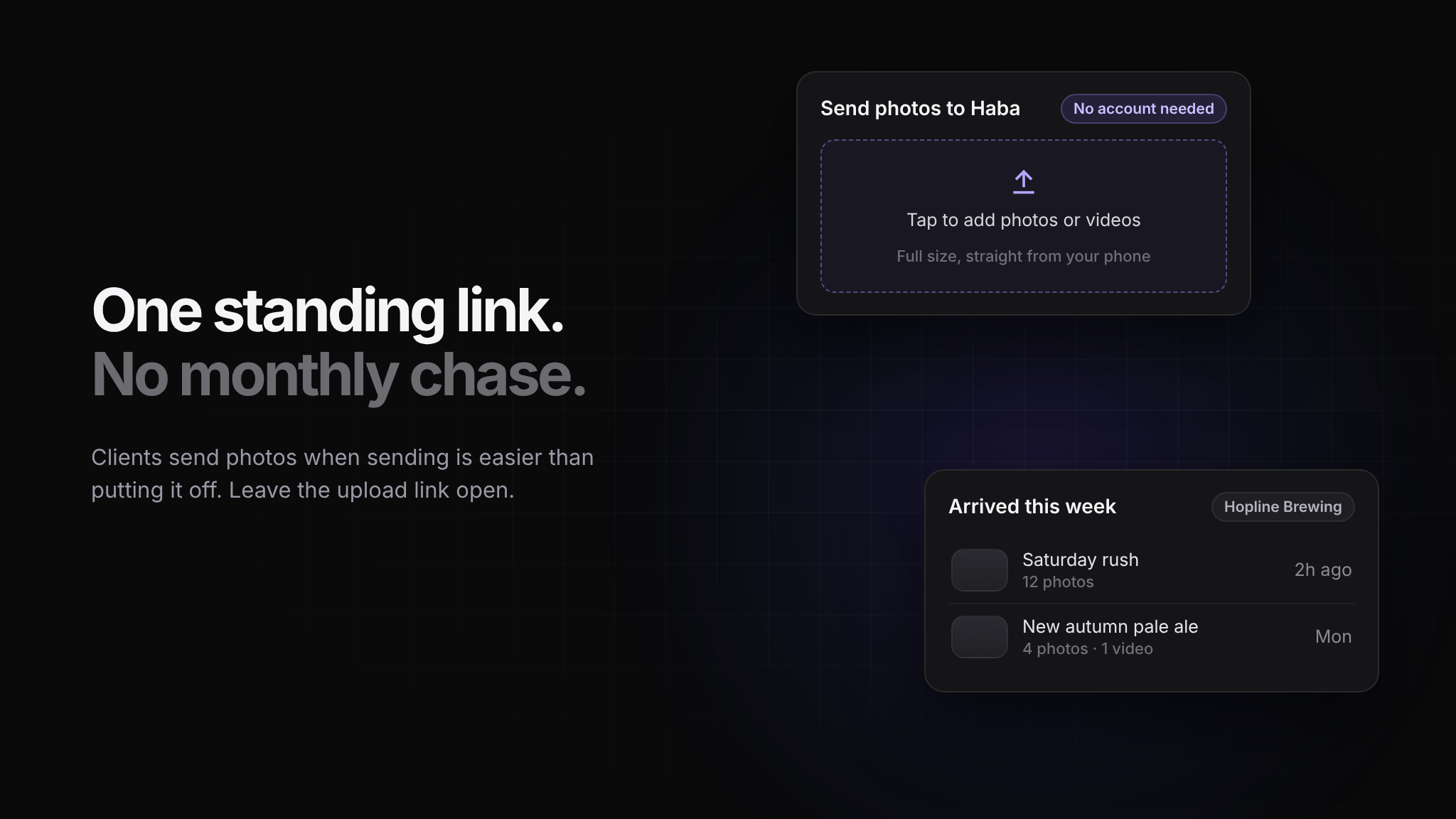
One link, no account
The request should be: tap this link, add your photos, done. No login, no app, no folder to navigate, no file size limit they have to think about. If a client can send you content from their phone while standing in their own shop, you will get content.
Anything that requires them to create an account will cost you a week and some goodwill.
Make it a standing link, not a monthly ask
Create one upload link per client and leave it open. Put it in their phone contacts, in your email signature to them, pinned in whatever chat you share. The best assets arrive when something happens, not when you ask: a new product on the shelf, a busy Saturday, a customer who loved their haircut.
A standing link turns asset collection from a monthly event into a background habit.
Give them a shot list, not a brief
"Send us some photos of the team" produces nothing. A numbered list produces photos:
Three shots of the front of the shop, one with people in it
The two new products on a plain surface, daylight
One photo of someone actually working, not looking at the camera
A short clip, ten seconds, of the room being busy
Specific is easier to act on than good. Clients are not withholding quality; they genuinely do not know what you need.
Set a date tied to something real
"By the end of the month" is not a deadline. "By Thursday, because we are scheduling the following three weeks on Friday" is, because it explains the consequence. Pair it with a default: if nothing arrives, you will publish from the existing library and the new products will wait until next month.
Say that once, follow through once, and the pattern changes.
Handle what arrives properly
Collecting is only half of it. The other half is not drowning in it.
Review before you file. Most of what arrives is unusable. Decide at intake whether each item gets scheduled, saved to the library, or discarded.
Keep the good ones permanently. A photo that works should end up in the brand's media library, not buried in a submission from eight months ago.
Let the rest expire. You are not a storage service. Anything you did not choose can go.
Separate by client and campaign. One shared inbox of everything from everyone is how the wrong photo reaches the wrong brand.
Open it up beyond the client
The person signing the invoice is often not the person near the content. Give the link to the photographer, the shop manager, the person running the stall at the weekend event. Anyone who might be holding a camera should be able to send you what they took without going through anyone.
That is usually where the best material comes from, and it is the material you would never have thought to ask for.
The short version
Stop asking people to send you files. Give them one link that always works, a list of what you actually need, a date with a reason attached, and the courtesy of reviewing what they send. The chasing mostly stops.