YouTube
The repost stopped counting
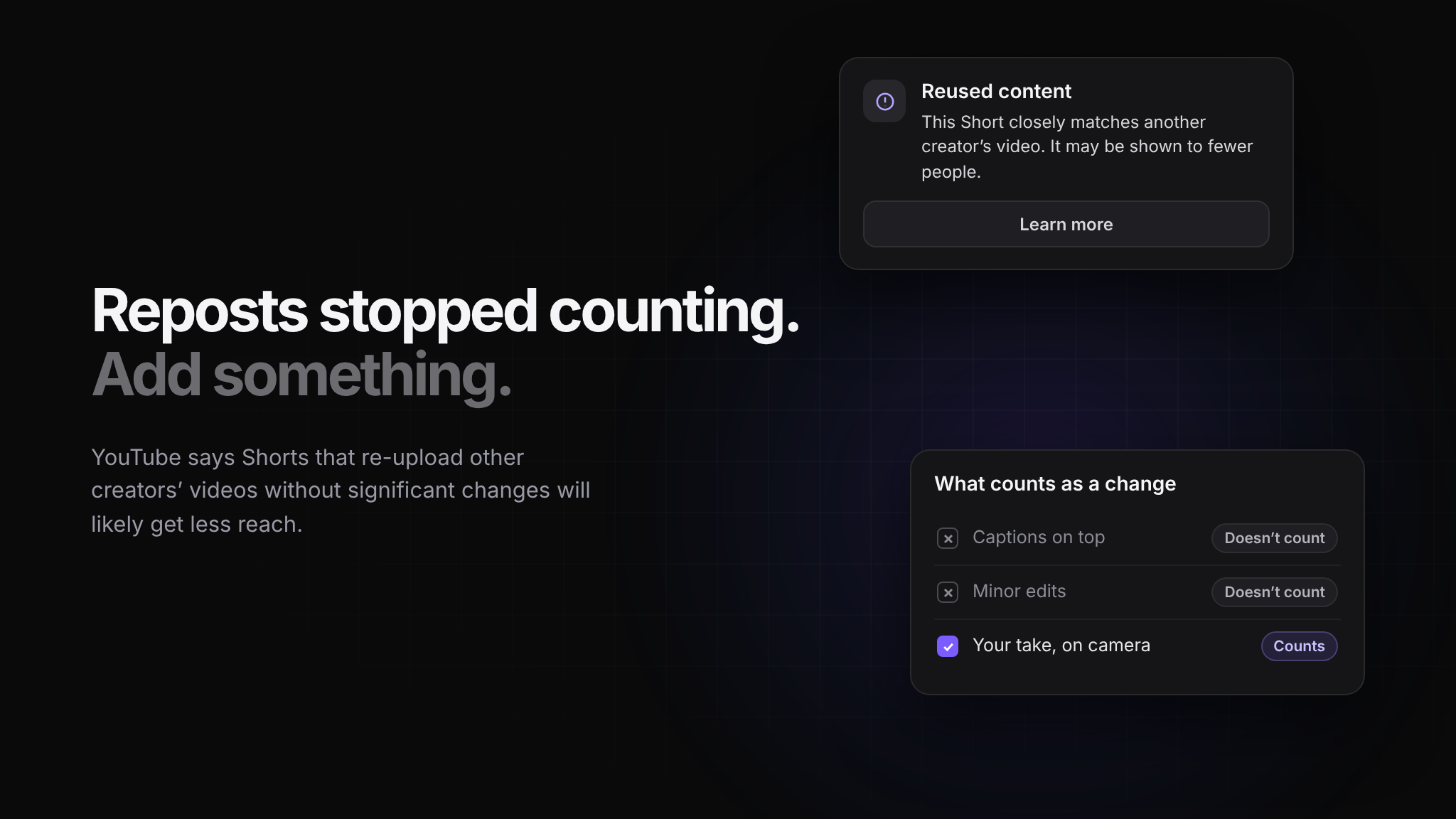
YouTube says Shorts that re-upload other creators’ videos without significant changes will likely get less reach. Captions and minor edits don’t count.
On this page
TL;DR
Reposting says, “Look what someone else made.” Transforming says, “Here’s what we think about it.”
YouTube says Shorts that re-upload other creators’ videos without significant changes will likely get less reach, and captions or minor edits don’t count.
Before you post, ask yourself: “What did we add that wasn’t in the original?”
Scroll through a brand's Shorts or Reels tab and you can usually spot the week the content calendar ran dry. There is the customer's unboxing, reposted whole; the creator's review, trimmed and captioned "we love this"; the clip from someone else's podcast with a logo in the corner. It fills the grid and it costs nothing. On YouTube, it is about to cost reach.
On 1 October YouTube said it is updating Shorts recommendations "to further prioritize original content and reduce the reach of content re-uploaded from other creators without adding anything of your own." Channels "primarily aggregating or re-uploading other creators' videos without significant changes will likely see less distribution within the Shorts feed." Instagram got there first, pulling aggregator accounts out of its recommendations, and Adam Mosseri says the reach of original content has grown since. Two platforms, one message: the feed pays whoever made the thing.
The edits that don't count
YouTube was clearer about what doesn't count than about what does, which is the useful part. "Rather than making minor technical edits or template-based changes simply to alter a video, focus on bringing your own voice," TeamYouTube wrote. Rene Ritchie, its creator liaison, went further on the Creator Insider channel: "not just VO descriptions of what's happening on screen, minor technical edits, or template-based bulk changes." By that standard a caption, a border or a speed change does not turn someone else's clip into yours. What does, in YouTube's words, is "original commentary, unique edits, or storytelling."
UGC was the loophole
Brands rarely think of themselves as aggregators. But a feed built on reposted customer videos is, mechanically, a feed of other people's uploads. The customer made it and you pressed share. That was fine when the job was social proof. It is weaker when the system is judging what you added.
The answer is not to stop using customers. It is to stop asking them for finished videos and start asking for raw material. Finished videos invite a repost. Raw material forces you to make something.
Ask for the album, not the edit
The platforms have quietly made raw material easier to collect. TikTok has been rolling out comments that hold up to nine photos, and creators can now add a poll with up to five options under their own videos. Posts that end "show us where yours ended up" gather whole albums in the replies. Polls let followers pick which story you tell next. In private, a WhatsApp group of your best customers does the same job.
Then do the part the platform now rewards. Put your voice over their photos and say something they didn't: why this setup works, what you would change, what surprised you. Cut three customers' versions of the same problem into one story. Ask permission in one line before anything goes public, and credit the person on screen. People overshare with peers and under-post for brands; the ask is what turns one into the other.
What isn't changing
This is about other people's videos. YouTube's wording targets re-uploads "from other creators", so cutting your own long-form or podcast into Shorts should be safe. It is a recommendation change, not a removal or monetisation rule, and YouTube has given no start date, no threshold and no Studio flag. There is a way back, too. "If your channel was previously aggregating or re-uploading and you shift towards original content," Ritchie said, "the recommendation system will re-evaluate reach." So judge it slowly. Tag your last 30 Shorts as made, transformed or straight repost, retire the third pile, and compare Shorts feed views over a month rather than reading tea leaves in a single upload.
The repost was always the cheapest content a brand could make. The platforms have noticed it was also the cheapest to watch.
Sources
Dexerto: YouTube cracks down on clipping channels (5 Oct 2026)
Android Authority: YouTube Shorts will prioritize original content over reposts (Oct 2026)
Kompozy: YouTube's reused-content reach cuts, with Rene Ritchie quote (Oct 2026)
Marketing Herald: YouTube cuts reach of channels reposting barely changed clips (Oct 2026)