YouTube
YouTube started answering before anyone clicks
YouTube is testing Ask YouTube answers at the top of desktop search, built from timestamped moments inside videos. Your chapters decide which ten seconds get quoted.
On this page
TL;DR
The old results page said, “Pick a video.” The new one says, “Here’s the answer, and here’s the ten seconds that prove it.”
YouTube is testing Ask YouTube answers at the top of desktop search for some signed-in US users, built from text plus timestamped moments inside videos.
Before you upload your next how-to, ask yourself: “If YouTube showed only ten seconds of this, would anyone still need to watch the rest?”
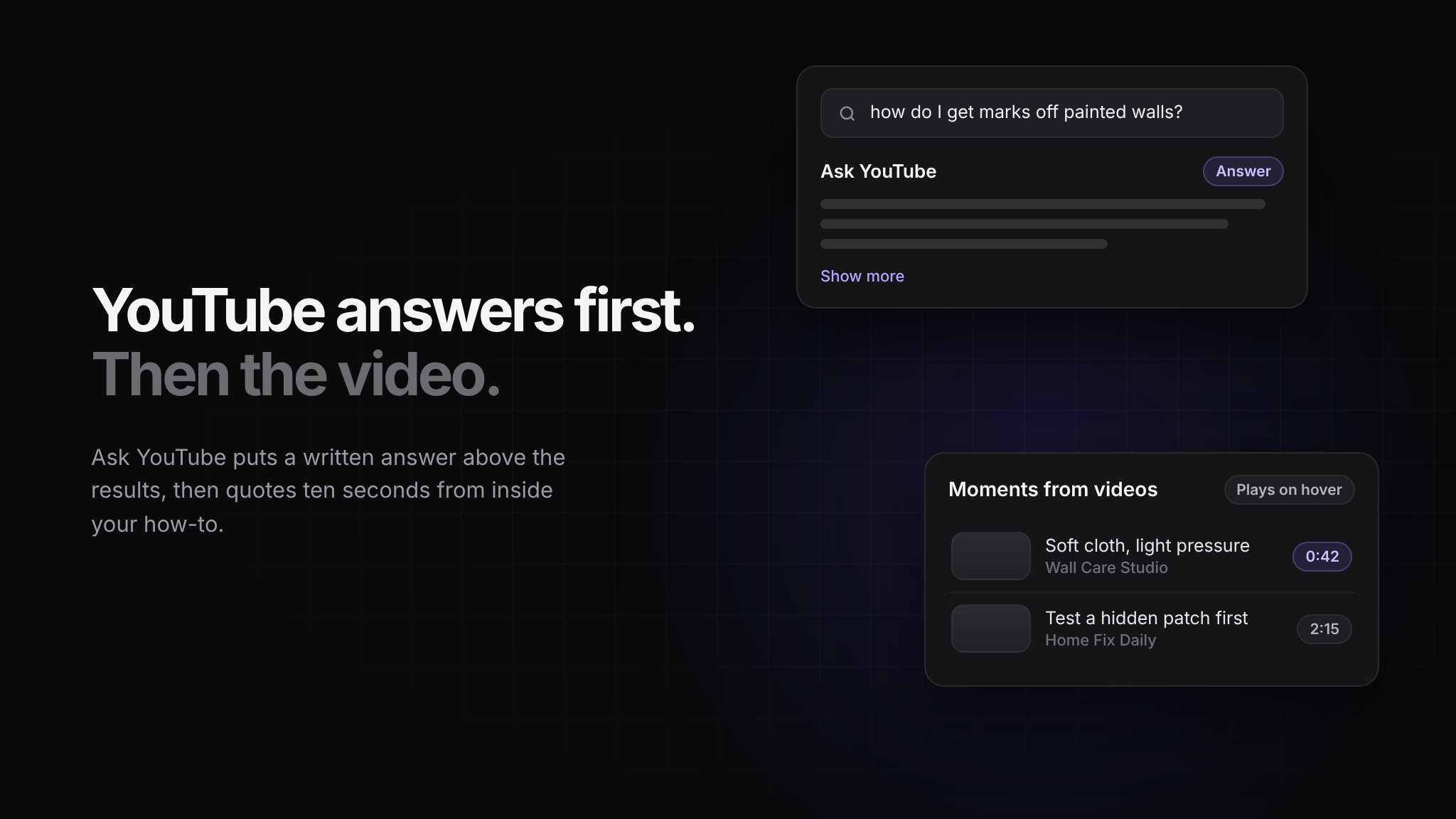
Type "how do I get marks off painted walls?" into YouTube and, for a small group of people, the top of the page is no longer a video. It is a reply. Text comes first, with short moments from relevant videos underneath, each one pulled from inside someone else's tutorial. The list of videos is still there. You just have to scroll past the answer to reach it.
YouTube added the experiment to its test features page on 15 October. It is live "for select signed-in desktop users in the US searching in English", and it appears when "a structured overview can add extra context beyond a standard list of videos": open-ended, how-to and skill-based questions without a single right answer. Viewers can tap Show more to open the full response and ask follow-up questions, or scroll down to the usual results.
The search box started talking back
Ask YouTube itself is not new. It began in April as an opt-in for US Premium subscribers, and on 12 October YouTube made it available to US viewers on web, mobile and TV. Until this week, though, you only got an answer if you asked for one. The test changes who sees it. Now the answer can arrive on its own, above the videos, for people who simply typed a question.
YouTube's help page describes how those clips behave. They show the channel name and video title, and they play on hover from the timestamp most relevant to the question. Put plainly, the preview does not recommend your video. It quotes it.
Blog posts have been here before
Anyone who wrote recipes or how-to articles for Google knows how this story goes. Search started answering the question at the top of the page, and the page that supplied the answer became a source rather than a destination. Android Authority made the comparison the day the test was spotted, and noted that YouTube's announcement says nothing about how creators are compensated when the answer does the job of the view.
YouTube's side of it, relayed by Uppbeat from a Creator Insider update, is that clicks from Ask YouTube count like standard search: impressions, views, watch time and ad revenue, including toward Partner Programme eligibility. That is true and it matters. It only helps, though, when someone clicks.
Watching still beats reading
Which videos keep the click? The ones where watching is the point. The preview can tell you to use a soft cloth on the wall. It cannot show you how much pressure lifts the mark without lifting the paint. Text summarises instructions well. It summarises demonstrations, faces, opinions and finished results badly.
So the how-to splits in two. The part that is really a list of steps will increasingly be read rather than watched. The part that has to be seen, the hands, the before and after, the person you trust saying "don't do this", is what sends people from the answer to the video.
Get quoted, then get watched
YouTube's own advice for appearing in these answers is unglamorous: relevant titles, detailed descriptions and clear timestamp chapters, which help match a viewer's question to a specific segment. Chapters are the hinge. They decide which ten seconds get pulled into the answer, and that clip is now the trailer for the whole video.
Two habits follow. Name each chapter after the task it covers, in the words people actually search. Then open every chapter with the thing text cannot do, the demonstration or the finished result, so someone arriving from an answer sees why the video exists before they decide the summary was enough.
Nobody outside a US desktop test will see this for now, and YouTube has given no date for a wider release. The habit it rewards is worth building anyway: make the right moment easy to find, and make the rest worth staying for.