TikTok
Your next customer searched TikTok first
Search on TikTok and Instagram is a shop window. Say the query, show it, caption it.
On this page
TL;DR
Scrolling says, “Entertain me.” Searching says, “Help me choose.”
TikTok and Instagram index what you say, show and write, so the exact words people search for matter.
Before you post, ask yourself: “What would someone type to find this?”
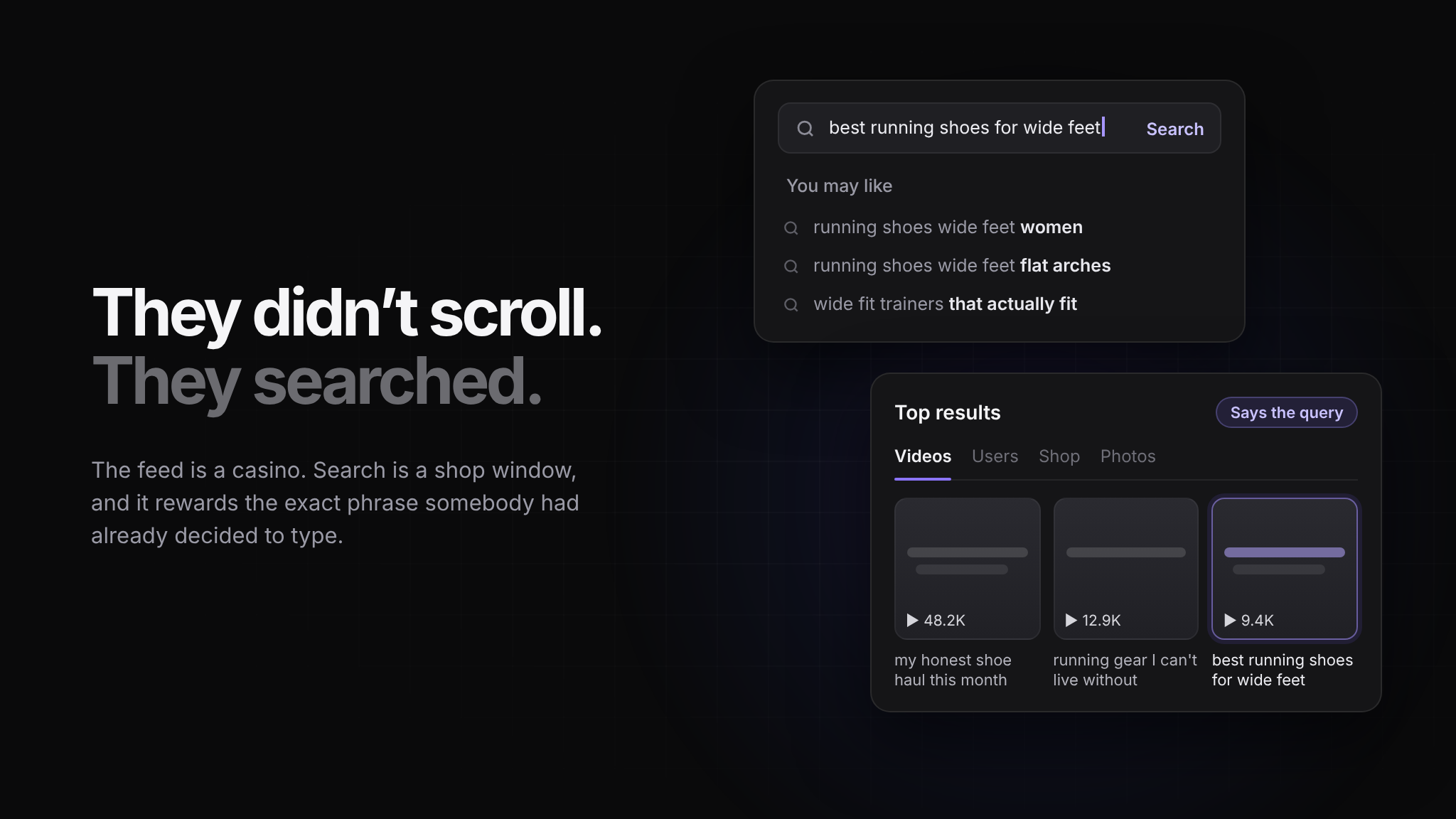
Spend enough time on social accounts and you notice a particular kind of comment. Under a perfectly ordinary video about running shoes, someone writes "finally, someone with wide feet", and a few replies down somebody else asks which size to order. Nobody found that video by scrolling. They opened TikTok rather than Google, typed "best running shoes for wide feet", watched three videos and bought what the third person was wearing.
That is a different kind of visit from the For You feed, and most short-form content is not built for it. If your videos only chase the feed, you are largely invisible in the query layer, which is where buying intent tends to live.
What the numbers actually say
Adobe Express surveyed 807 US consumers and 200 small-business owners in January 2026 and found that 49% of consumers have used TikTok as a search engine, up from 41% in its 2024 survey. That is worth taking seriously, though it is not the same as saying Google is finished. Google still wins on preference, and in the same survey ChatGPT was the louder challenger, with 14% of consumers saying they were more likely to use it than Google. Adobe's figures also suggest that only 4% of Gen Z are more likely to rely on TikTok than Google, down from 8% in 2024.
The better reading is that search now has several doors. TikTok's advantage lies in how it feels to decide: a short video, a real person and some social proof, all in one scroll. Instagram is the quieter twin, where keywords in captions, bios, on-screen text and alt text matter and Reels are the searchable format. Instagram's own creator guidance lists keywords alongside sharing and saving as ways to be discovered, which is rather different from a block of hashtags.
TikTok has even built a tool for it. Creator Search Insights, documented in its Help Centre, shows what people search for, filters for content gaps and search popularity, and reports how your posts perform in search; the view of what your followers search for needs 1,000 or more followers. The feed is temporary, but search results linger.
The casino and the shop window
The For You feed behaves like a casino, rewarding novelty and a bit of luck. Search behaves more like a shop window, rewarding the exact phrase somebody had already decided to type. And people want more than the best answer; they want one that feels safe to choose, which usually means someone like them, in a kitchen like theirs, saying the product name out loud. Video search is social proof with a transcript attached.
None of this is mysterious. Platforms index what you say, what you show and what you write. Most creators put their effort into a fourth thing, hashtags, and neglect the first three, which is why so much perfectly good content ranks nowhere.
Treat each video as an answer
The useful shift is to treat every Reel as a landing page for one question: say it, show it, caption it. Say the exact query in the first three seconds, since TikTok transcribes speech. Put the same phrase on screen in the first frame. Use it in the first line of the caption, followed by two to four search-dense paragraphs with related terms rather than a minimalist one-liner. Then add three to five niche hashtags and drop #fyp. One video, one query, and no lifestyle mush.
Before the next video goes out, it helps to finish this sentence:
Someone will find this by searching [phrase].
If the blank fills itself, you have probably made an answer. If the best you can manage is a vague category, the video is trying to answer everything and will most likely rank for nothing.
The obvious place to start is the search bar itself. Type your five most important product or category words into TikTok and Instagram and note the autocomplete suggestions, because those are real queries. Pick one phrase that Creator Search Insights marks as a content gap, rebuild a single Reel around it, and for the next seven days watch saves and search-driven views rather than For You reach alone. The video that wins may not be the one with the most views, but the one that keeps getting found.