Client reporting
Social media client reporting that actually renews the retainer
Most agency social reports are a screenshot of follower growth and a hope. Here is what to put in a monthly report so the client can see the value without you explaining it.
On this page
A monthly report is the one deliverable every client definitely reads. It is also the one most agencies treat as admin: export some numbers, paste them into last month's deck, change the date, send it at 6pm on the last day.
That report is why renewal conversations are harder than they should be. If the client cannot tell from the document whether the money worked, they will fall back on gut feel, and gut feel is a coin toss.
The question a report has to answer
There is only one: did this month move the business?
Everything in the report either helps answer that or is padding. Follower count usually does not help. Impressions rarely help. A grid of every post's engagement rate definitely does not help, because the client has no way to act on it.
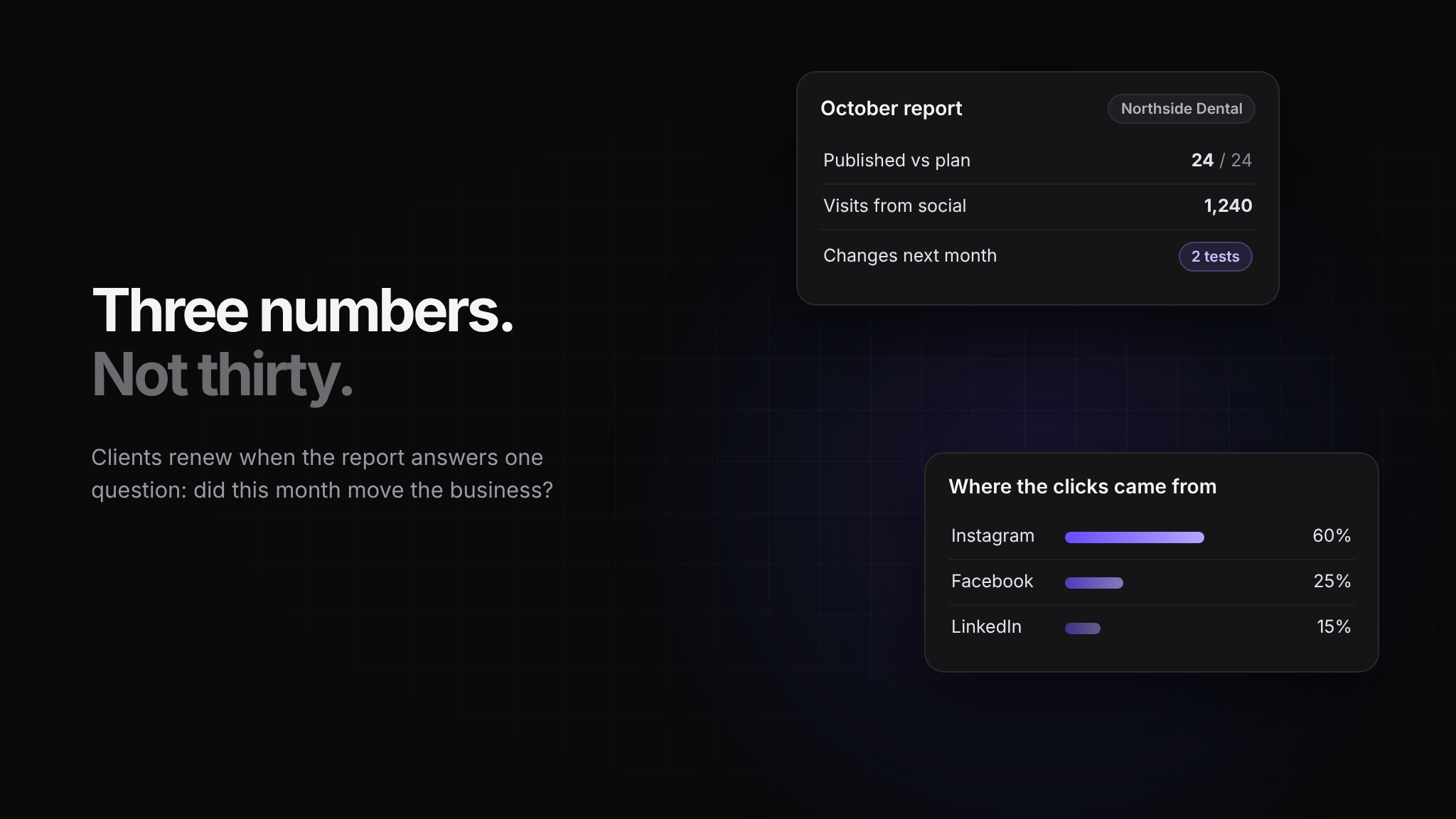
Three numbers, not thirty
1. What we published, and against what plan
Start with delivery. Posts published, by brand and by network, against what was agreed. This is the least interesting number to you and the most reassuring one to a client who is paying a retainer and cannot see the work.
If you underdelivered, say so here with the reason. Burying it is how a small problem becomes a trust problem.
2. What it drove
Not reach. Clicks, and where they went. This is the number most agencies cannot produce, which is exactly why it is worth producing.
If every link you publish is tracked and tagged, you can say: this month social sent 1,240 people to the site, 60% of them from Instagram, and the three posts that drove the most traffic were these. That is a sentence a client can take to their own boss.
Untracked links make this impossible. If you take one thing from this piece, make it this: tag your links before you need the report, not after.
3. What we learned, and what changes next month
Two or three sentences. One thing that worked and will be repeated, one thing that did not and will be dropped. This section is why the client keeps paying for a person rather than a scheduling tool.
What to cut
Vanity totals with no baseline. "4,300 impressions" means nothing without last month beside it.
Per-post tables. Nobody reads row 19. Show the top three and the bottom one.
Platform jargon. Save reach, impressions and ER for your own analysis. Translate for the report.
Anything you cannot explain. If you cannot say why a number moved, either find out or leave it out.
Make it skimmable in sixty seconds
Assume the person opening it has one minute between meetings and will forward it to someone more senior. That means:
A one-paragraph summary at the top, written in plain sentences.
Numbers with a comparison beside them, not in isolation.
Your branding, not your tool vendor's.
A live dashboard link alongside the PDF helps more than it sounds like it would. The PDF is the artefact for the meeting; the link is what the client checks on a Tuesday when someone asks how social is doing.
How to handle a bad month
Lead with it. Name the number, give the reason, state what you are changing. A report that opens with a flat month and a clear plan reads as competence. The same report with the bad number on page six reads as something else, and clients notice which one they received.
Make it boring to produce
The best reporting process is the one you are still following in month nine. If the report takes a day to assemble, you will start cutting corners, and the first thing to go is the analysis that made it valuable.
Pull the numbers automatically, keep the commentary short, and spend the time you save on the two sentences that say what happens next.