Meta ads
Launching an ad? 50 conversions a week please, or we waste your money
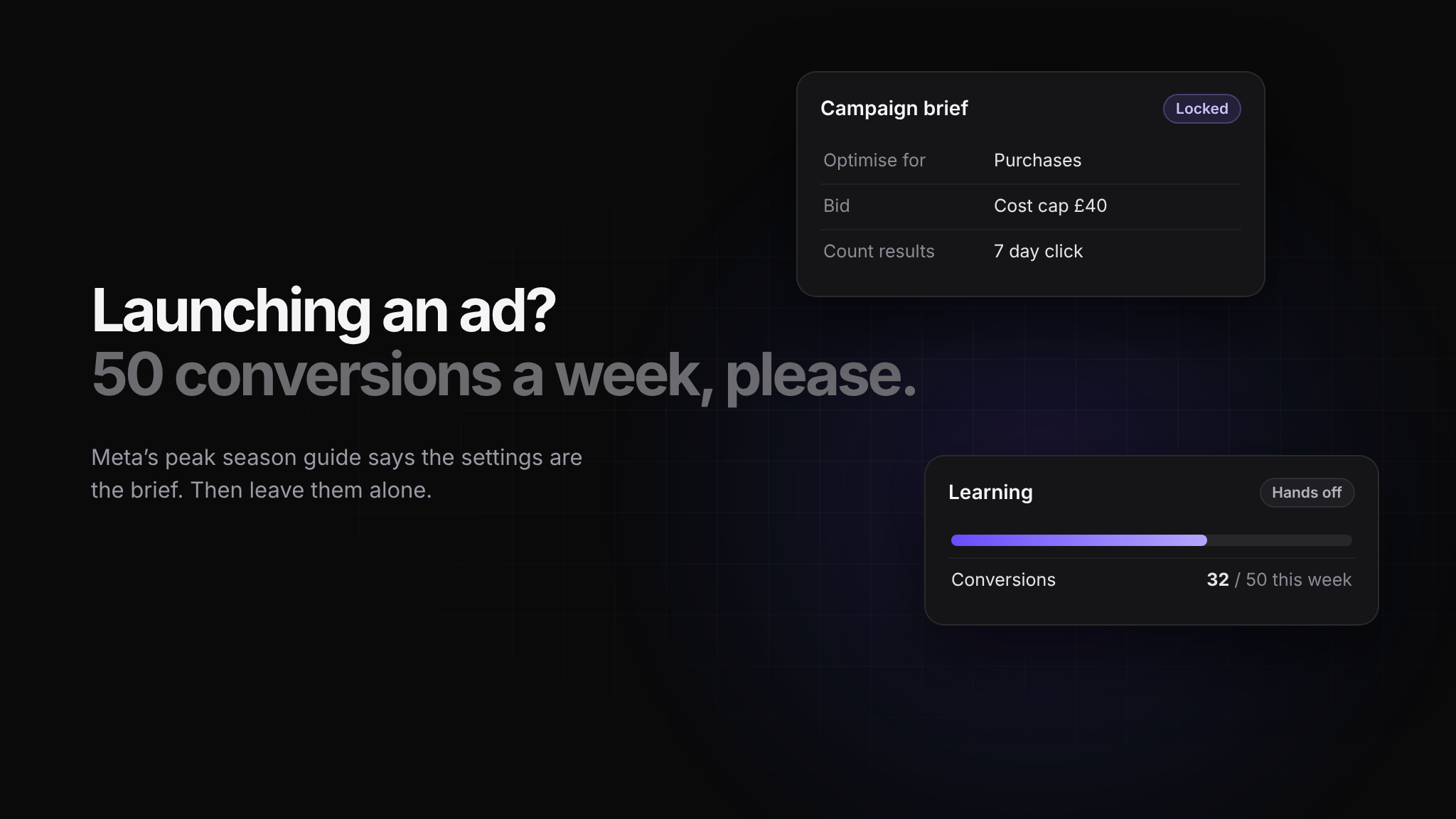
Meta’s 21 October peak season guide says ad sets under roughly fifty conversions a week cost about 28% more per purchase, by Meta’s own figure. Write the brief, then leave it alone.
On this page
TL;DR
The dashboard says, “Do something.” Meta says, “Write it down, then leave it alone.”
Meta’s peak season guide says ad sets getting fewer than roughly fifty conversions a week ran about 28% more expensive per purchase in its own analysis.
Before you launch, ask yourself: “Could I explain this campaign’s brief in three lines, and would I keep my hands off it for a month?”
Open almost any ad account in late October and the change history tells the same story. The campaign dipped on Tuesday, got a new audience on Wednesday and a bigger budget on Thursday, then recovered on Friday. Thursday’s change gets the credit. Nobody checks whether Friday would have happened anyway.
Meta has now written that habit up as the problem.
Every setting is a sentence
On 21 October Meta published a peak season post on its Meta for Business site titled “Peak Season 2026: You Don’t Beat The Auction. You Brief It.” Its argument is that the settings in Ads Manager are the brief. “The optimisation event is the ask. The budget is the constraint. The bid strategy is the definition of success. The attribution setting is how you agree to be judged.”
The difference from briefing a person, Meta says, is that the auction never pushes back. “It accepts everything. It reads what you wrote, decides you meant it, and goes and buys it.” Bad briefs don’t start an argument. They produce, in Meta’s words, “a perfectly executed wrong answer, delivered on time and inside budget.”
The number, and its catch
Then comes the number. “Give each ad set enough volume to learn from. Roughly fifty conversions a week. Below that the system is guessing. In our analysis, ad sets under that threshold ran about 28% more expensive per purchase.”
Treat the 28% as Meta’s figure. The post gives no sample, period or method, and PPC Land points out the obvious catch: ad sets with small budgets are both less likely to reach fifty and likely to cost more for other reasons. The fifty itself isn’t new. It has been Meta’s rule of thumb for leaving the learning phase for years.
The more useful line is the formula Meta prints in bold. Divide your total weekly budget by fifty times your cost per result, and you get the most ad sets your budget can support. In PPC Land’s worked example, $20,000 a week at $40 per purchase supports ten. At $100 per purchase, the same money supports four. Costs rise in peak season, so the ceiling falls just as most accounts add campaigns. Meta says “most accounts are running more than that.”
The cost nobody sees
Every edit, Meta says, costs twice. You pay once for the restarted learning phase, and once for the weeks the old, wrong instruction ran “at full price”. Only the first shows up anywhere in the account.
That asymmetry explains two habits Meta names. Advertisers “leave a bad brief running because changing it feels risky. Then they tinker with a good one because tinkering feels like work.”
That second sentence is the one worth sitting with. Changing things looks like managing. Leaving things alone looks like neglect, even when leaving it alone is the job. Dashboards refresh every few minutes and present normal daily wobble as if it were news, so the person who touches the campaign most often can feel like the person working hardest. The auction doesn’t reward effort. It rewards the instruction.
Patience, and permission
The timing has its own irony. Meta asks advertisers to hold one campaign still and measure it for “the month of October”, in a post published with ten days of October left. From 28 October Meta also switches product browsing on in existing ads unless advertisers opt out. By the guide’s own logic that is a rebrief too, just one nobody on your side wrote. Monday’s post, “Your ad has a co-author”, covered that half.
So the honest reading is narrower than the headline. Meta wants fewer, bigger ad sets and fewer edits, which also happens to suit its automation. Some of it is plainly right: thin ad sets learn slowly, and a written change log beats anyone’s memory of what happened last Thursday. The way to find out whether the rest holds for your account is the one Meta itself recommends, an A/B test or a Conversion Lift study, read “against something rather than against last month.”
Write the brief like you mean it. Then have the nerve to leave it.