Meta ads
Your ad has a co-author
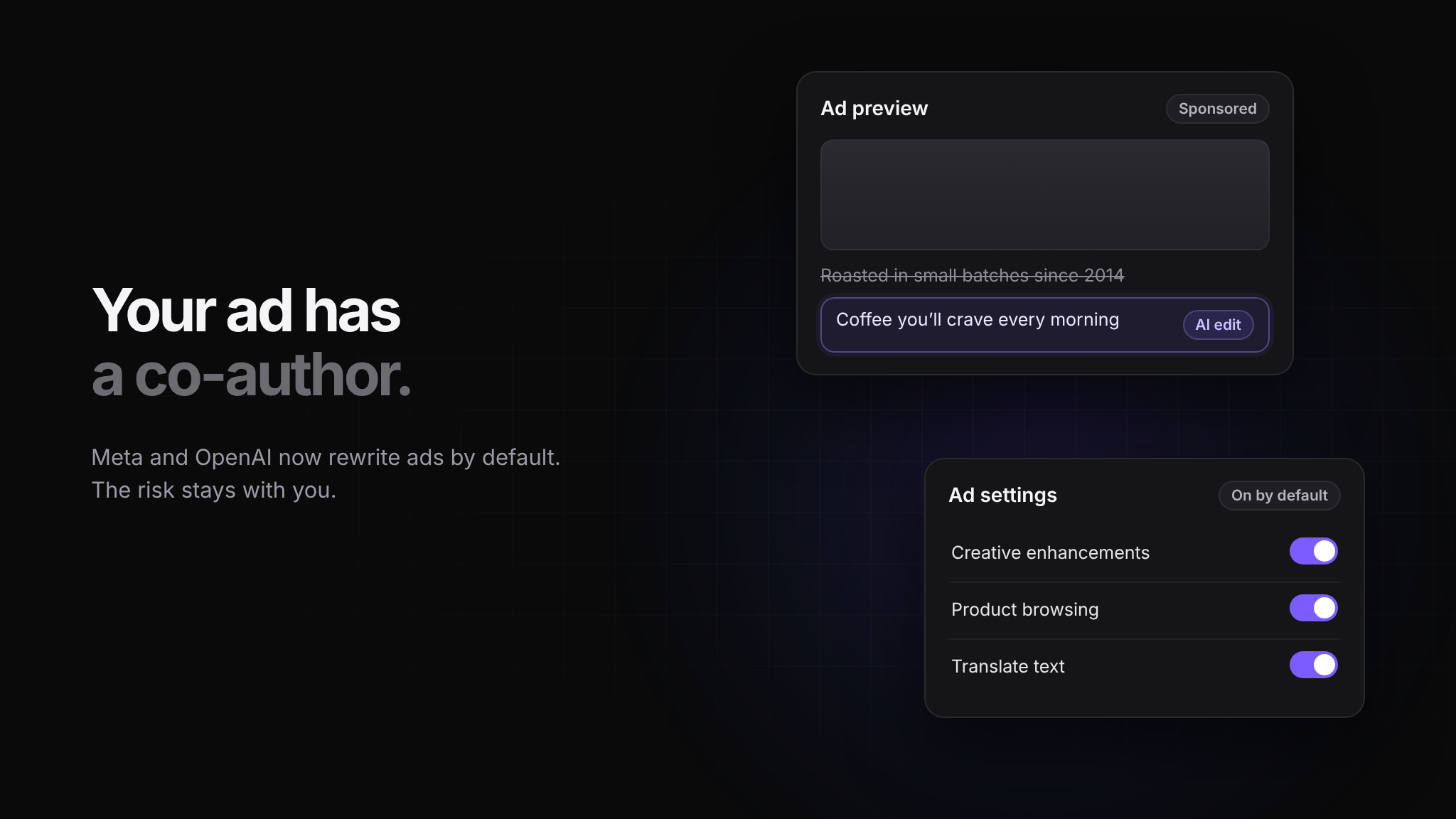
Meta and OpenAI now rewrite ads by default, and Meta’s new terms put the risk on the advertiser. Sign-off has to move upstream.
On this page
TL;DR
The brief says, “Here is our ad.” The platform says, “Here is our version of your ad.”
Meta’s revised business terms, now due on 20 November, add an AI Features section that, by Adweek’s reading, makes advertisers “solely responsible” for whatever Meta’s AI creates or changes in their ads, including features Meta switches on itself.
Before you post, ask yourself: “Would I sign off on every version of this ad, including the ones I never see?”
For most of advertising’s history, the hard part was getting the ad made. Once it was signed off, it stayed signed off. The copy that legal approved was the copy that ran, and if something went wrong, everyone knew whose name was on the brief.
That arrangement is quietly ending. In the space of a week, the two companies selling the most automated ad space said their machines will rewrite your ads by default, and that what comes out is still yours.
Meta wrote the clause
On 22 October Adweek reported that Meta’s revised Commercial Terms contain a new section titled “AI Features”. Under it, according to Adweek, advertisers are “solely responsible” for what Meta’s AI creates or changes in their ads, and that reaches features Meta enables itself. The terms warn that the AI “may make mistakes and may not always produce accurate, complete, or suitable results.”
The earlier wording put the risk on advertisers who chose to use Meta’s creative AI. The new section, on Adweek’s reading, drops the choosing.
The terms were due on 30 October. Publishers then objected to a separate clause about crawling their websites, and Meta pushed the whole update to 20 November, a date its Business Help Centre now confirms. Meta told Adweek it is folding its existing generative AI ad terms into its main ones and that advertisers can switch off individual Advantage+ features in Ads Manager at any time. It did not say directly whether advertisers are liable for features they never turned on.
The edits are already running
None of this would matter much if the machine only did what it was asked. Several agencies told Adweek it does more. Exverus says Meta’s tools have added sitelinks, translated copy and built AI images and carousels from a brand’s own photos, sometimes on ads where nobody switched those features on. “Many of the options are tucked away in hidden or collapsed menus,” its paid social specialist said. Bookshop.org said on Threads that an account update opted it into a generative feature that added an AI illustration to an ad people had drawn.
Then there is the tap. Meta has told advertisers that from 28 October it will add product browsing to existing ads unless they opt out, so a tap may open an in-app page with product details and “personalized suggestions” before anyone reaches your site. The notice cites 3% more conversions on average from Meta’s own August test. It does not say which conversions, or where they were counted, and Meta has not published a help page on the change.
OpenAI did the same thing the same week
On 20 October OpenAI told ChatGPT advertisers it would switch on creative enhancements for new and existing campaigns. The system can rewrite headlines and descriptions, translate text, resize images and change the destination URL. Its help page says enhanced versions “can run automatically without requiring you to review or approve each version”, and that there is no preview of every variation.
The start date keeps moving. The email said 30 October, the help page said 29 October, and this morning it says 31 October. Whichever day it lands, the default flips this week for anyone who hasn’t opted out.
Sign-off moved upstream
Here is the shift worth noticing. Sign-off used to happen at the end, on the finished ad. Now the finished ad may not exist until a stranger sees it, assembled on the spot from your words, your photos and a model’s guess about what will convert. Nobody can approve every version, so approval has to move to the settings, the source material and the landing page the machine reads from.
That is less dramatic than it sounds. It means treating your product feed, your landing pages and your raw photography as copy, because the machine will quote them. It means one named person who knows which toggles are on in each account. It also means deciding, account by account, which brands can tolerate a rewrite and which cannot: anything regulated, anything priced, anything with a legal line.
Used well, automation can lift results. Meta and OpenAI both say it does, with their own numbers. The point is not to refuse it. The point is to choose it rather than inherit it, because the terms are clear about who carries the risk either way.
Sources
PPC Land: Meta makes advertisers solely responsible for its AI ad edits (22 Oct 2026, citing Adweek)
Meta Business Help Centre: Streamlining Meta’s Commercial Terms (effective 20 Nov 2026)
The Verge: Meta delays new business terms after publisher pushback (23 Oct 2026)
PPC Land: Meta will turn on product browsing in existing ads on October 28 (15 Oct 2026)
Search Engine Land: ChatGPT Ads to enable creative enhancements