Pinterest put the ad inside the search
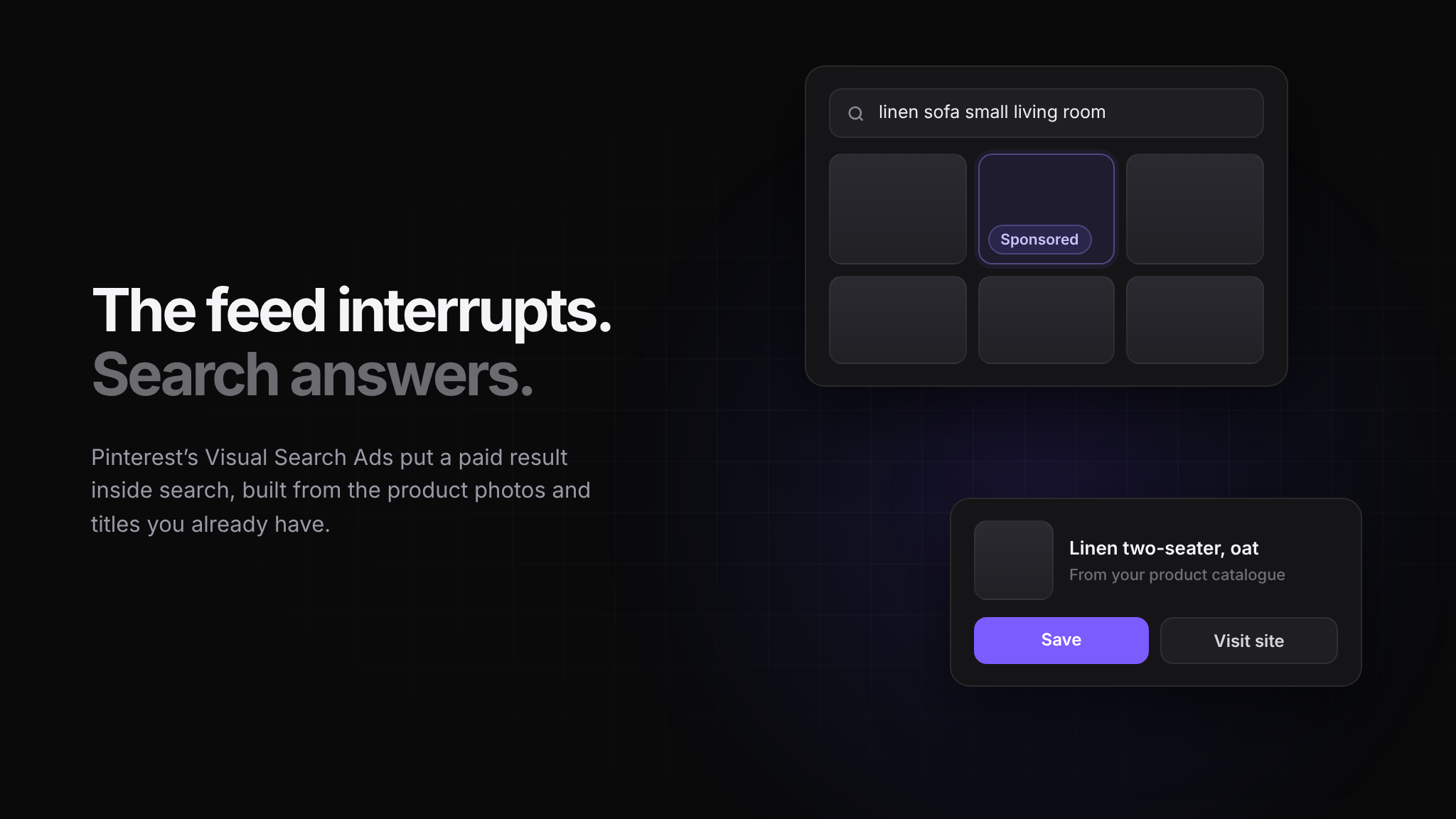
Pinterest’s Visual Search Ads put a paid result inside search, built from your existing product images and titles. Your product photo now has to win a shortlist.
On this page
TL;DR
The feed asks, “Will this stop the scroll?” Search asks, “Is this the answer I was hunting for?”
Pinterest’s Visual Search Ads put a paid result inside search results using your existing product images and titles, but the beta has not reached most UK accounts yet.
Before you post, ask yourself: “Would my product photo and title look at home in this search grid?”
Watch someone use Pinterest with money in mind and the pattern barely changes. They type "green velvet sofa", or photograph a lamp in a friend's flat, then work through a grid of near-identical answers: save three, tap one, go back, tap another. It looks like browsing. It is a shortlist being built.
Pinterest has noticed what it is sitting on. At its advertiser summit on 17 September it announced Visual Search Ads, which put a paid result inside search results and inside the Pin closeup, the screen people land on when they tap a Pin to look properly. Advertisers bid for a top spot and the click goes straight to their own site. Pinterest says its users run more than 80 billion searches a month, most of them visual and more than half of them commercial. On 6 October it repeated that the beta would reach eligible advertisers in all of its ad markets "in the coming weeks". For British brands that means soon, not yet.
The feed interrupts. Search answers.
Most Pinterest budgets we look at are bought like any other social budget: a feed placement, a broad audience and a hope that someone stops. That suits Instagram, where people go to be interrupted. Pinterest is closer to a shop window the customer arranges. Someone searching "autumn wedding guest dress" is not killing time. They have a date, a budget and a firm idea of what they don't want.
In that grid, an ad is not an interruption. It is one more candidate. That changes the job. The question stops being will this stop the scroll? and becomes does this look like the answer they were already hunting for?
No new creative, which is the catch
Pinterest's pitch is that brands need "no net new creative". Chloe Wix, its vice president of go-to-market, says the format works with "the campaign assets that they already have". That sounds like a gift. It is also a warning. If the ad is your existing product image and title, the ad is only as good as your catalogue.
Many retail catalogues on Pinterest read as if written for the warehouse: collection names, style codes, "Midi Dress Navy 4402". Shoppers don't search like that. They type "navy midi dress with sleeves" or "wedding guest outfit". Pinterest's visual matching can do a lot with pictures, but a white-background packshot still looks odd in a grid of styled rooms and real outfits. The brands that do well here will be the ones whose product photos already look like Pins.
Measure the shortlist, not the glance
Pinterest pitches the format as lower-funnel, and it has not yet published conversion rates or any comparison with its existing ads. Until it does, every claim about returns is a guess, including any you read this week. The honest test is narrow: one product group, one clear conversion, and a comparable campaign or holdout running alongside.
The early signal worth watching is not impressions. It is saves and outbound clicks from search. Saves mean someone put you on the shortlist. Clicks mean they went to check the price.
Do the work before the button appears
The beta is weeks away for most accounts, which is the useful part. Pull the ten searches that matter most in your category from Pinterest Trends, run each one yourself and screenshot the top of the grid. Put your own product image and title beside it and ask, honestly, whether it belongs there. If it doesn't, reshoot the photo in context and rewrite the title in the words people actually typed. That work pays off in organic search today, and it is exactly the material Visual Search Ads will use tomorrow.
Shoppers on Pinterest have already done the hard part. They told you what they want. The ad just has to look like it.