Meta ads
Creator posts became a media line
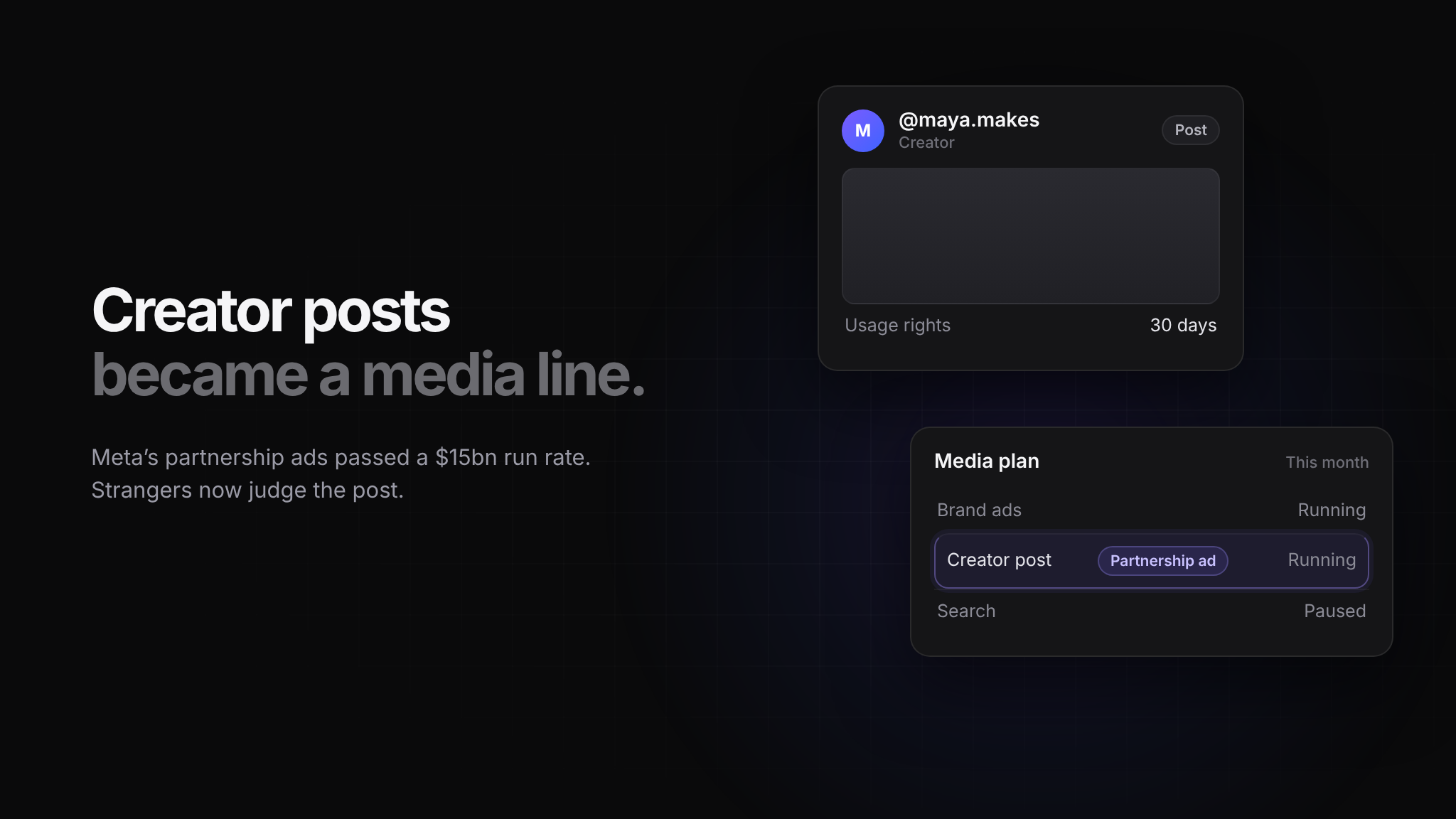
Meta says partnership ads grew more than 97% in a year and passed a $15bn run rate. Once creator posts sit in the media plan, strangers judge them, not followers.
On this page
TL;DR
The old pitch said, “Look how many people follow me.” The new one says, “Here’s what my post did as an ad.”
Meta says partnership ads, where a brand pays to run a creator’s post, grew more than 97% in a year and passed a $15 billion annual run rate.
Before you post, ask yourself: “If this ran as an ad for a month, would it earn what was paid for it?”
Look at the branded posts in a mid-sized creator’s grid and you can usually spot the ones the brand paid to push. They open with the same line as the brand’s own ads, show the product in the first second, and have comment sections full of people who don’t follow the creator. The post was written for the followers. It ended up working for the media plan.
Meta has now put a number on how far that has gone.
The number on the call
On Meta’s third quarter earnings call on 21 October, CFO Susan Li said: “Our partnership ads product grew over 97% year over year and surpassed $15 billion in annual revenue run rate.” Partnership ads run under a creator’s or partner’s name with the brand alongside, and the brand pays to put them in front of people.
Two caveats are worth keeping. The $15 billion is a run rate, which annualises recent revenue rather than reporting it, and Meta doesn’t break partnership ads out in its accounts. PPC Land notes that Meta gave a $10 billion run rate in the first quarter, so by Meta’s own figures the line grew by about $5 billion in two quarters.
Li also said Meta had “completed the global rollout of Creator Marketing Hub to all advertisers,” bringing “creator discovery, content organization, and partnership ad activation into one place with more than 10 million creators now discoverable.” Meta is adding its AI Business Assistant to the Hub so advertisers can “conversationally search for creators.”
What changes when it’s a line item
Money that sits in a media line gets managed like media. Someone compares it with the other lines, asks for cost per result, and moves budget to whatever wins. Influencer budgets used to be judged on feel: reach, vibe, whether the founder liked the video. Partnership ads get judged in the same Ads Manager columns as everything else.
That moves value in two directions. For brands, the creator’s post stops being a one-off and becomes creative they can run, test and scale, so the clause that says how long they can run it matters as much as the post. For creators, the post now earns twice, once as content and once as an ad. Most creator rate cards still only price the first.
It also changes what a good creator post is. Organic posts are judged by the creator’s own audience. Partnership ads are judged by strangers who’ve never heard of the creator, in a feed full of other ads. One post can be loved by followers and still lose the auction, while another that felt flat on the grid becomes the account’s best ad. Earlier this month we noticed that nobody is searching for follower counts anymore. Search inside the Hub, and a chatbot that finds creators on request, push the same way. The creator who gets picked is the one whose content fits, not the one with the biggest number.
The quieter shift
Nobody at Meta said creators are now ad inventory. The numbers said it. When one product nearly doubles in a year inside an ad business growing 26%, it tends to get more tools, more placements and more prompts in Ads Manager. Expect more brands to ask for usage rights by default, and more creators to find their old branded posts still running.
Creators who treat the brief like an ad brief and the contract like a media buy will do well. So will brands that stop asking “How many followers?” and start asking “How did this do when strangers saw it?”
Sources: Meta Q3 2026 earnings call transcript, The Motley Fool (21 Oct 2026) · PPC Land: Meta's ads with creators gain 97% to a $15bn annual run rate