Meta ads
Five seconds, seven times
Meta says five seconds of attention spread across a week beat one continuous five-second view, and it is testing a metric that counts the week. Your first two seconds need to look like you.
On this page
TL;DR
One long view says, “They watched our ad.” Five short ones say, “They’re starting to know who we are.”
Meta says its research found five seconds of attention spread across a week drove 32% more offline sales than one continuous five-second view, and it is testing a metric, Aggregated View Time, that counts attention that way.
Before you post your next short, ask yourself: “If someone saw only two seconds of this, would they know it was us?”
Watch how most brand teams review their Reels and you see the same ritual. Each post gets judged on its own. The one with the big number earns a sequel, the one that stalled takes its format down with it, and nobody asks whether the same person saw the brand three times that week.
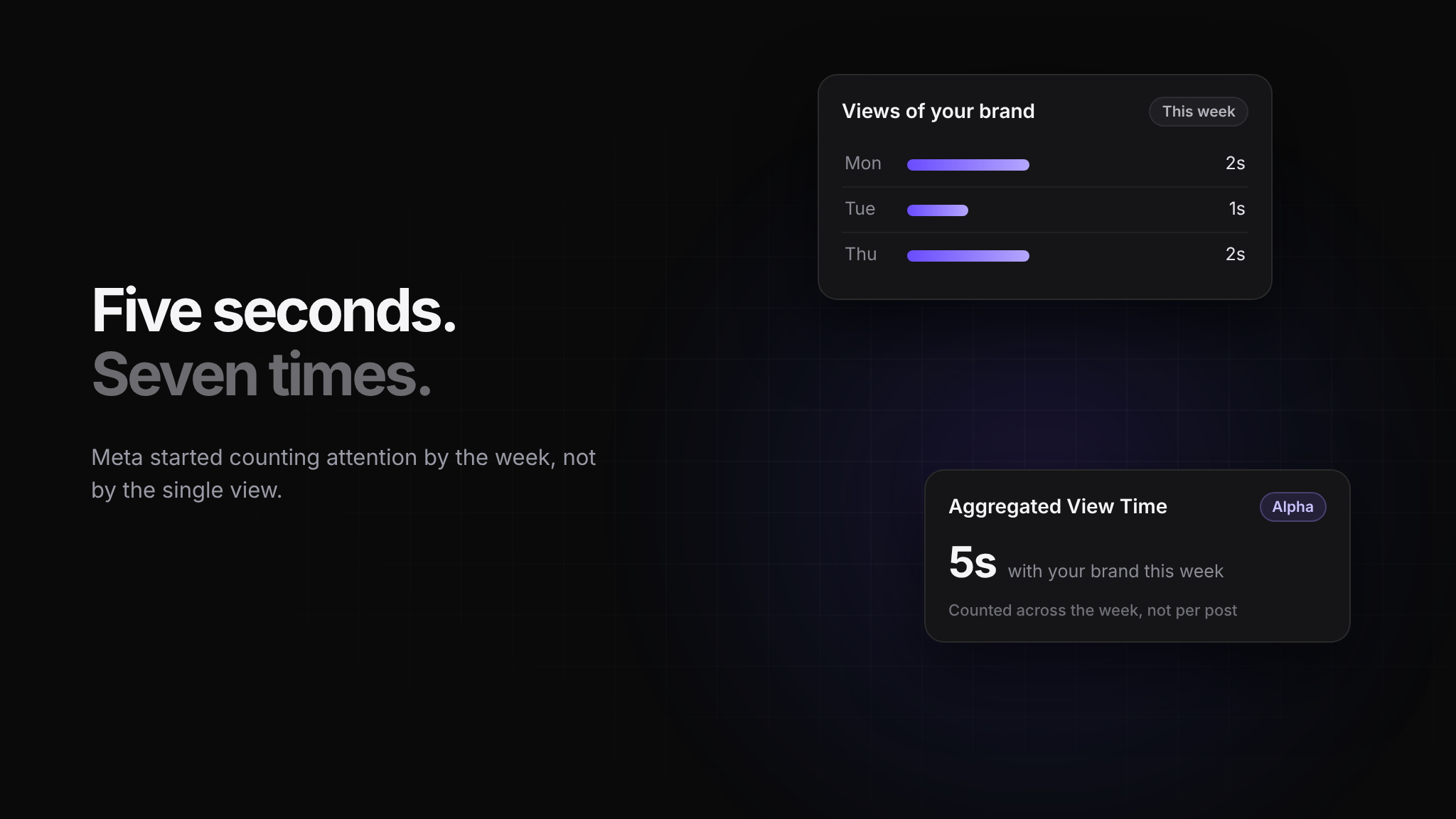
Meta now says that is the wrong unit. At its Brand Building Summit on 15 October it described someone seeing a brand "for two seconds in a feed, then one second the next day, then two more seconds on Thursday." Counted post by post, none of those views looks like anything. Counted across the week, they add up to five seconds with the brand.
Meta started counting the week
Meta's claim is specific: "Our research found that five seconds of attention added up over a week drove 32% more offline sales than one continuous five second view." It adds that independent industry research found the same pattern, with accumulated seconds predicting outcomes better than one long view. Neither study is named on the page, so for now this is Meta's number about Meta's own ads.
The product built on it is called Aggregated View Time. It is in alpha, Meta gives no date and no list of advertisers, and it describes the goal as a way to "measure and optimize the total time someone spends with your brand across a week, instead of each impression on its own."
That second verb is the interesting one. Measurement changes the report you read after a campaign. Optimisation changes what the delivery system chases while the campaign runs. If Meta starts rewarding weekly time with a brand, the creative that wins is the one people give two seconds to again and again, not the one that holds a single long view.
Television taught us the wrong habit
Meta puts it bluntly: the industry treated a long view as proof an ad worked "because that is how television worked." On TV, the viewer sat still and the ad ran. In a feed, the viewer is moving and the brand gets whatever fragment it can earn before the thumb does its job.
People have always learned brands this way. Familiarity builds through repeated small encounters, which is why a jingle heard in passing outlasts most ads anyone watched closely. Short video simply makes the fragments smaller and more frequent. What the long-view metric missed was never attention. It was memory, and memory is built by repetition.
Two seconds has to be enough
If attention arrives in pieces, every piece has to carry the brand. Look at your last ten shorts and most of them will save the name, the logo or the product for the end, which is exactly the part fragment viewers never reach. The opening two seconds are spent on a hook that could belong to anyone.
The accounts that build recognition in a scroll do the opposite. Same colour in the first frame, same sound, same face, same line. None of those cues makes a single post perform better. Together they let five scraps of attention across a week land as one impression instead of five strangers.
It also changes how you judge formats. One weak post tells you very little when the outcome you care about is a week of encounters. Give a format a week of repetitions before you decide it doesn't work.
Same summit, opposite bet
Meta sold the other side of the argument in the same announcement. Ads Super Burst lets advertisers book a window of three to 24 hours at what Meta calls TV-like scale, with category exclusivity available, planned in Reach Planner with guaranteed delivery tied to its estimates. Meta says testers saw a median 2.9 point lift in ad recall, and the product is moving to general availability this month in phases. First Impression Ads, the first ad someone sees in their Facebook Feed, are being tested in the US with one brand per day.
So Meta is pitching both: the big booked moment and the many small ones. Most accounts will never buy the first. Everyone controls the second, because it costs nothing to make your first two seconds recognisably yours.
Aggregated View Time may stay in alpha for a while. The habit it rewards is worth building now.