Watch time is the rent. Sends are the referral.
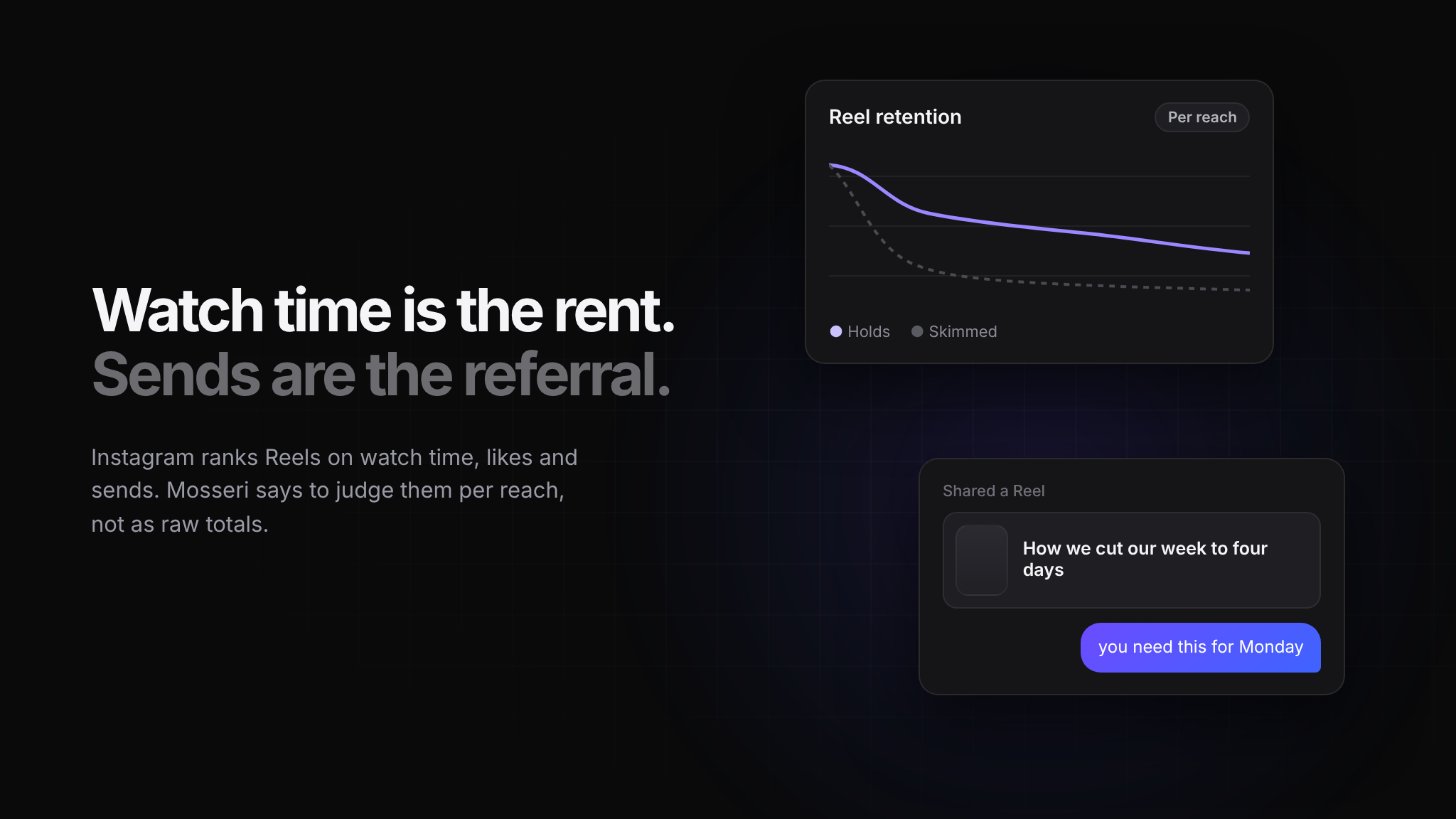
Instagram ranks Reels mainly on watch time, likes and sends, judged per reach. Raw views are the wrong scoreboard.
On this page
TL;DR
Views say, “I saw it.” Watch time says, “I stayed.” Sends say, “You need this too.”
Instagram ranks Reels mainly on watch time, likes and sends, and Mosseri says to judge them per reach, not as raw totals.
Before you post, ask yourself: “Why would someone watch to the end, and who would they send it to?”
Most weekly Reels reports still open the same way: views first, then likes, then a polite shrug at reach. It is a familiar scoreboard and a misleading one. Instagram does not reward a big number for its own sake. It rewards attention that sticks, and attention that leaves the building.
What Mosseri actually said
In January 2025 Adam Mosseri named the three signals that matter most for Reels ranking: watch time, including the chance someone finishes; likes; and sends. He also told creators what to look at in their own insights: average watch time, likes per reach and sends per reach. One nuance still holds. Likes count for a little more when the viewer already follows you, and sends count for a little more when they don't.
Put more plainly, likes keep the living room warm, sends get you invited to the next party, and watch time is the rent. Miss enough payments and the landlord, in this case Explore and the Reels feed, stops renewing the lease.
Instagram's own Reels tips guide, refreshed on 28 September 2026, makes the same bet out loud. Reels that perform can land on Explore, which is "built for reach beyond your existing followers"; they should engage from the first second and be original. Length is presented as a format choice rather than a growth hack: 3 to 15 seconds for punchlines, trends and transitions; 15 to 60 seconds for tutorials, day-in-the-life clips and most creative formats; one to three minutes for a longer story or walkthrough. Padding a 12-second idea to 45 seconds because longer supposedly means more watch time is a reliable way to lose completion. The systems can tell the difference between easy to finish and too good to stop.
Why views mislead
Views are a proxy harvest. You chase a loud number because it once stood in for people caring, and platforms eventually notice the proxy has been gamed and switch to signals that are harder to fake. Watch time is hard to fake; you cannot pod someone into staying for the payoff. Sending is harder still, because it carries a social cost: the sender is staking their taste in someone else's messages. The scoreboard that matters, then, is not how many people saw it but, of those who did, who stayed and who passed it on.
Build for hold and travel
The useful shift is to give every Reel two jobs. The first is to hold, earning each next second and above all the first three, ideally with the promise on screen from the opening frame. The second is to travel, giving someone a reason to press send: a line, a punchline, a payoff that makes them think of a particular person. Three plays of a 15-second Reel beat one 60-second Reel abandoned at 20. Stop padding and start looping.
Meta's new Edits assistant, rolled out in the US on 30 September, can help with the first job. It reads your retention, likes, shares and comments and surfaces patterns, which makes it useful for spotting what held. It does not make the cut for you. Meta's own framing is that the analysis is the tool's job and the creative call stays with the creator.
Before the next Reel goes out, it helps to finish this sentence:
Someone will watch to the end because [why], and send it to [who].
If both blanks fill themselves, you are probably onto something. If neither does, the Reel is likely to be long on runtime and short on reasons.
Better scoreboards need surprisingly little. For your last five Reels, it is enough to log five things: length, average watch time as a percentage of runtime, sends per reach, likes per reach and a short note on the hook and the send moment. Compare like with like, at the same age (day seven against day seven) and similar length, and never call a 12-second Reel weak because it lost to a 45-second one on raw seconds. Then try a small experiment: cut one abandoned Reel down to the length people actually finish, and test a replayable 15-second version of an idea against a 45-second once-through, keeping the pattern that wins rather than just the views. If you have Edits in the US, ask it which recent Reels held past three seconds and which died. Finally, swap one vanity line in the client report for sends per reach and average watch percentage, and let the room argue about the right number. Rent first, referral second, vanity last.