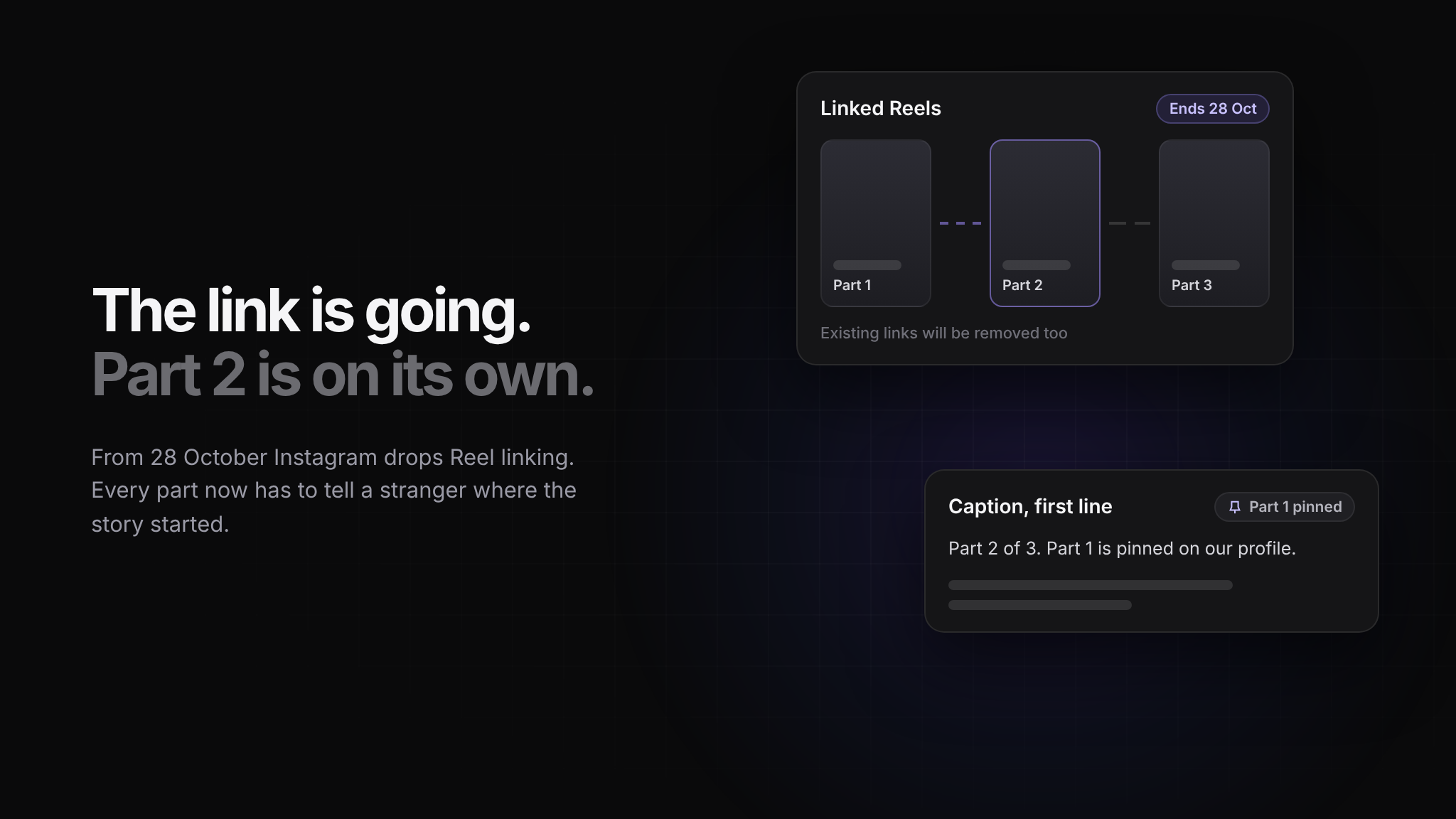
Sends beat likes. Design for the DM.
Likes are applause. Sends are recommendations. Design for the DM, not the heart.
On this page
TL;DR
Likes say, “I enjoyed this.” Sends say, “You should see this too.”
Instagram uses sends to help decide which posts to show people who don’t follow you.
Before you post, ask yourself: “Who would someone send this to, and why?”
There is a better question than "will people like this?" It is: who would they send it to?
Think of the last five Reels you sent someone. You probably can't remember whether you liked them first, but you remember the person they made you think of: the colleague who got one because it was painfully accurate, the partner who got the restaurant, the friend who got the stupid video that needed no explanation beyond "you".
That behaviour matters. Instagram's Adam Mosseri has repeatedly pointed to sends as an important signal, particularly when Instagram is deciding what to show people who don't already follow you. Which makes sense: a like is easy, a send is a recommendation, and recommendations travel.
Make something for the DM
Much social content is still designed for the feed: a nice image, a good caption, an appropriate hashtag, perhaps a tasteful request to "like if you agree". But the interesting bit happens elsewhere, when someone presses the little paper plane and thinks of a name.
Every post therefore has two audiences: the person seeing it, and the person they might send it to. The second is easy to forget.
So before publishing, ask who this will make someone think of. Not "marketers", not "founders", but an actual type of person: the founder who still insists on approving every Instagram caption, the friend who sleeps in her makeup, the media buyer who launches campaigns without a brief. The more recognisable the person, the easier the send.
People don't send "good content"
They send things that are useful, or funny, or that make them look clever for finding them. Above all, perhaps, they send things that let them say:
This is you.
That is a different creative brief from "make an engaging Reel". You start looking for recognition rather than engagement. The joke gets more specific; the advice gets useful enough to hand to somebody. You stop ending every post with "what do you think?" and occasionally give people a reason to send it on.
Reputation comes into it too. When you send someone a post, you are in effect telling them it is worth 30 seconds of their life. So make it worth passing on.
Before the next post goes out, it helps to finish this sentence:
Someone will send this to [who] because [why].
If the blanks fill themselves, you are probably onto something. If the answer is "anyone interested in our product", go back to the post: you have probably made a brochure, and brochures don't get DMed around group chats.
And for a week, it is worth worrying a little less about hearts. Look at sends and saves, then at the posts that produced them. What was the opening line? Who was it obviously for? What made somebody think of another person?
You may find that your best-performing content is not what wins the most applause but what starts a conversation somewhere you can't see. Design for that conversation.