Instagram wants today’s Reel
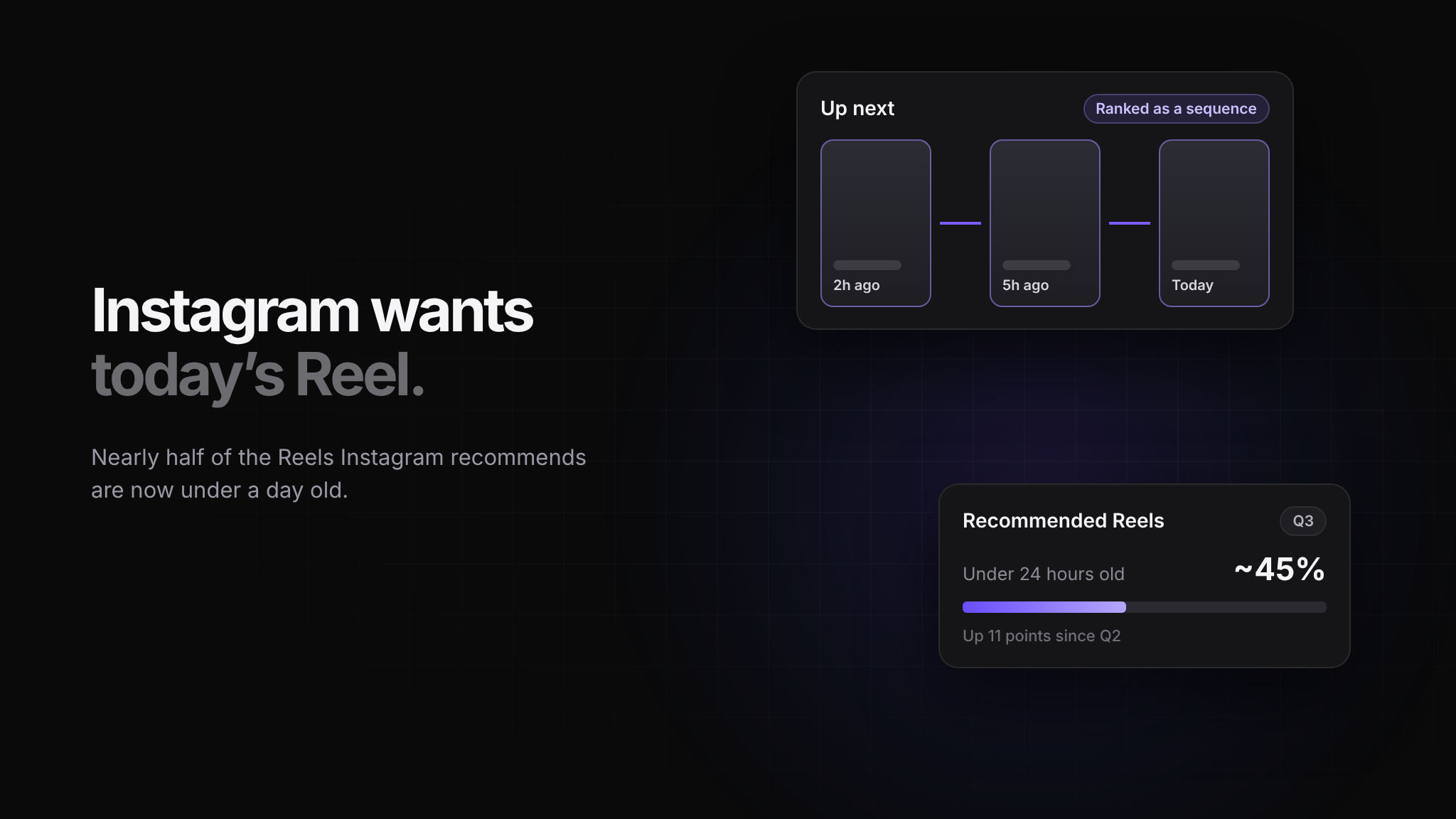
Meta says almost 45% of recommended Instagram Reels are now less than a day old. The recommendation engine reads like a newspaper, not a library.
On this page
TL;DR
Old Reels say, “This did well last month.” Fresh Reels say, “This is happening now.”
Meta says almost 45% of the Reels Instagram recommends are now less than a day old, up more than 11 percentage points in a quarter.
Before you post, ask yourself: “Why would someone want to watch this today, rather than someday?”
Earnings calls are sales pitches to investors, and the useful lines for anyone who posts are usually buried in the finance chief’s remarks. Meta’s call on 21 October had two worth underlining.
Nearly half of it is new
Susan Li, Meta’s CFO, said almost 45% of recommended Instagram Reels are now less than one day old, an increase of more than 11 percentage points from the second quarter. She tied it to Meta’s “relevance launches”, which she said lifted Reels time spent by over 4%.
Read that number as a shelf life. Nearly half of what Instagram puts in front of people was posted in the last 24 hours. Meta didn’t say how old the rest is, but the direction is plain: a Reel that stalls on its first day is now competing with tomorrow’s batch, and tomorrow’s batch is what the system prefers.
It fits the year Instagram has had. Since April it has been pulling aggregators and copycats out of recommendations. Once reposts stop counting, what is left to recommend is whatever was made recently, by whoever made it.
The machine reads before the crowd votes
Facebook added the second clue. Li said Meta finished a global launch of a new retrieval system for Facebook Feed and Reels that labels posts by meaning and helps “surface relevant new posts before they’ve accumulated significant engagement.” It now handles roughly a quarter of unconnected Feed views and half of Reels views.
For years the rule was simple: a new post needed early likes before strangers ever saw it. Meta now says its systems can judge a post on what it is about before the crowd has voted. That makes the post itself do more of the work. If the first frame and first line don’t say what the Reel is, the machine has less to go on and nobody has voted yet.
Reels are judged in a row
The other line is quieter and possibly bigger. Instagram’s upgraded model, Li said, “ranks sequences of Reels at a time, instead of evaluating each Reel independently.”
That changes the unit. Your Reel is no longer only scored against its own merits. It is scored as the next thing in someone’s run of viewing. Meta hasn’t explained what makes a Reel a good next step, so treat any rule here as a guess. The sensible reading is that a Reel which starts on its point fits a sequence better than one that needs a run-up, and a Reel with a clear topic is easier to place next to the right neighbours. Last Friday’s post, “Five seconds, seven times”, made the same point about brands: people meet you in fragments, between other things.
More newspaper than library
Put the three lines together and Instagram looks less like a library, where good work waits on the shelf to be found, and more like a newspaper, where today’s edition is what gets read. Libraries reward the back catalogue. Newspapers reward being on time and being clear in the headline.
None of this means old work is worthless. Your best evergreen Reels still belong pinned to your profile and in carousels people save. But the recommendation engine, the place most new viewers come from, is telling you its appetite. It wants this morning’s bread.