Agency growth
How to price social media management without pricing per post
Per-post pricing punishes you for getting good at the job. Here is how to structure retainers so the margin holds as the work gets more efficient.
On this page
Ask ten social media agencies how they price and most will describe some version of a package: twelve posts a month, two platforms, one report, a number. It is easy to quote, easy for the client to compare, and it quietly guarantees that your margin can never improve.
Why per-post pricing caps you
If you charge per post, you have told the client that posts are the product. Two things follow.
First, every efficiency you gain is passed straight to the client. Get twice as fast at producing a post and you have not earned more; you have just lowered your own rate. The only way to grow revenue is to produce more posts, which means hiring, which means managing, which means your margin stays where it started.
Second, you have invited a comparison you will lose. There is always someone who will do twelve posts for less. When the unit is a post, the only axis left is price.
The agencies that hold healthy margins on social are not the ones producing the most content. They are the ones who priced something else.
Price the outcome, scope the inputs
The structure that tends to hold:
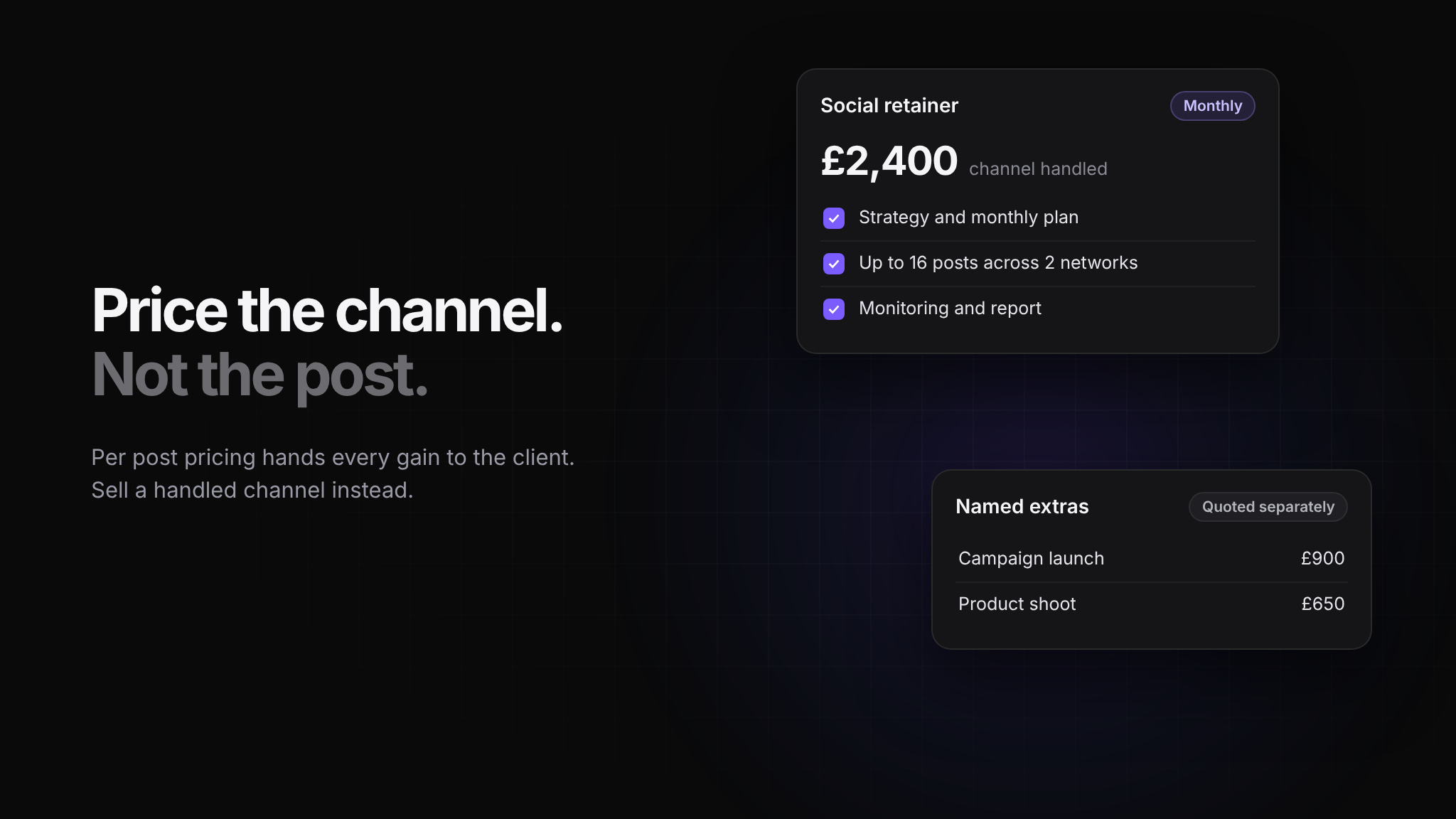
A base retainer for the thing the client actually buys: that their social presence is handled, consistently, by people who know what they are doing. This covers strategy, the monthly plan, publishing, community monitoring at an agreed level, and reporting.
A defined scope that says what is included in volume terms, so the retainer is not infinite. Volume is a boundary, not the product.
Named extras for work that is genuinely additional: a campaign, a shoot, paid social management, a platform launch, crisis response.
The difference from per-post pricing is subtle on the invoice and significant in the conversation. You are not selling twelve posts. You are selling a handled channel, with twelve posts as the agreed cadence.
Put the real costs in the scope
Most retainers lose money on things that never appear in the quote. The usual culprits:
Revision rounds. Unlimited revisions are a liability. Two rounds included, further rounds billed, is normal and defensible.
Approval delay. If the client sits on approvals for a week, your schedule breaks and you absorb the rework. Put a response window and a default action in the scope.
Asset collection. Chasing photography is real work. Either include a defined amount of content capture or state that assets are the client's responsibility by a given date.
Ad-hoc requests. The Friday afternoon "can we also post about this" is fine once and ruinous as a habit. Define how many of these the retainer absorbs.
Meetings. A monthly call is a retainer. A weekly call plus a standing channel is a different price.
None of this is about being difficult. It is about the quote reflecting the job, so you are not renegotiating in month four from a position of having already underpriced.
Tiering that is not just more posts
Three tiers where the only difference is volume teaches the client that volume is all you offer. Better axes:
Number of platforms, since each one adds real production work.
Analytics depth, from a monthly summary to attributed traffic and a live dashboard.
Response times, both for publishing and for community management.
Strategic input, from executing an agreed plan to quarterly strategy sessions.
Content production, from publishing what the client supplies to producing it yourself.
A client who wants attributed reporting and a quarterly strategy session is buying something meaningfully different from one who wants twelve posts, and will pay accordingly.
Work out your actual cost per client
Before setting any price, find out how many hours a client currently consumes, including the invisible parts: chasing approvals, assembling the report, hunting for assets, fixing a failed post, the Slack messages. Most agencies are surprised, and the surprise is usually in the coordination rather than the creative.
That number tells you two things: what the retainer has to clear, and where to spend effort reducing cost. Cutting three hours of coordination per client per month across fifteen clients is a part-time hire you do not have to make.
Raise prices on the existing book
The hardest part. A few things that make it survivable:
Do it at a natural boundary, usually the annual renewal, not mid-term.
Give a full cycle of notice.
Tie it to something the client can see: added reporting, a platform, faster turnaround.
Accept that you will lose one or two. The ones you lose are usually the ones consuming the most unbilled time.
Pricing is the highest-leverage thing in an agency, and the one most people avoid revisiting because the conversation is uncomfortable. It is still cheaper than hiring your way out of a thin margin.