One million people pressed the slop button
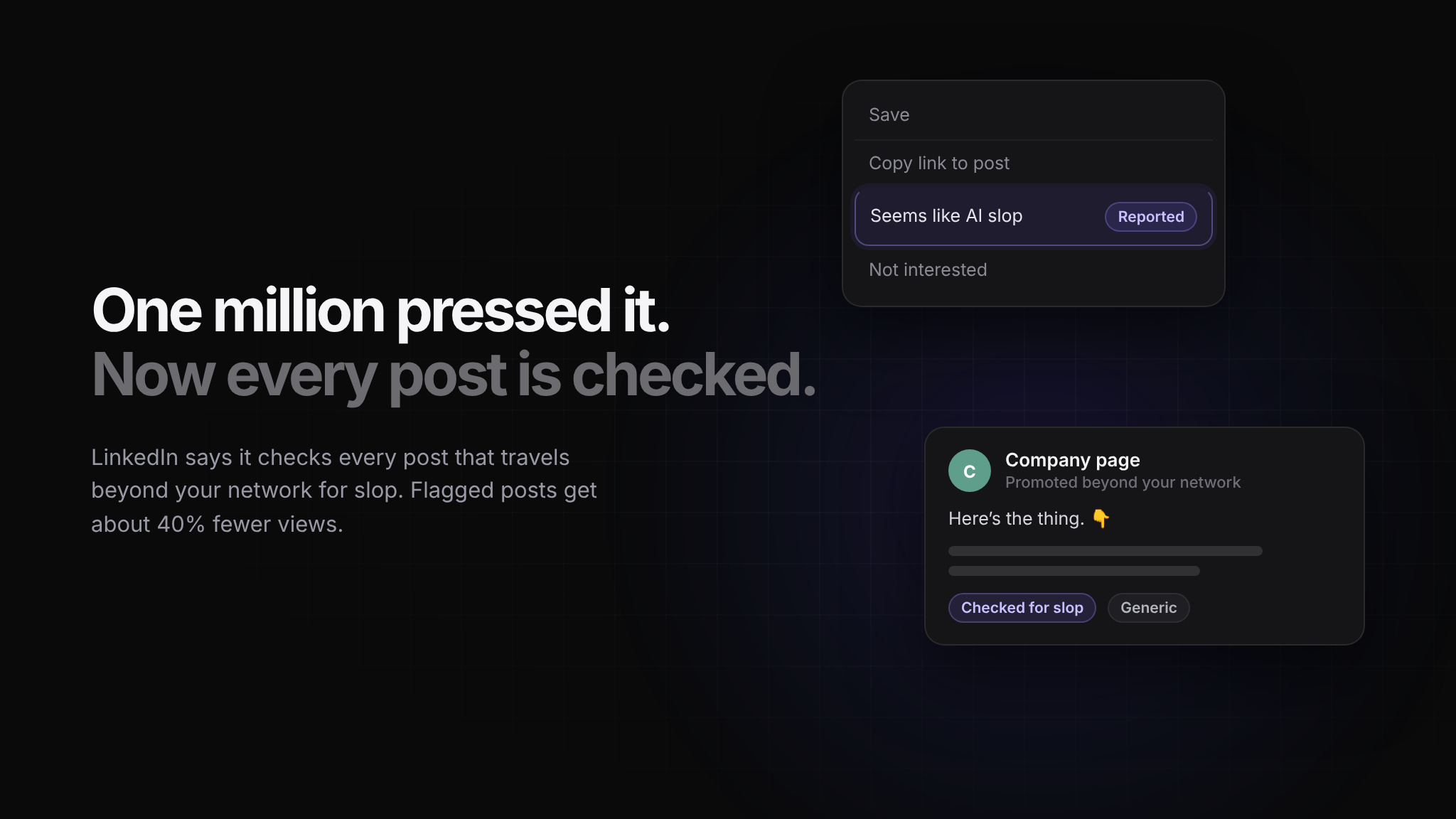
More than a million LinkedIn members used the new “Seems like AI slop” option in under three weeks. Posts it flags get about 40% fewer views.
On this page
TL;DR
Generic posts say, “Anyone could have written this.” Specific ones say, “Only we could have.”
LinkedIn says it now checks every post that travels beyond your network for slop, and that posts it flags get about 40% fewer views.
Before you post, ask yourself: “Could a competitor publish this unchanged?”
Scroll through a dozen company pages on LinkedIn and the template shows itself fast. There is the one-line hook, then the line break, then "Here's the thing." Three bullet points with emoji follow, and a question at the end asks what you think. Swap the logo and nobody would notice.
LinkedIn's members noticed. This summer the platform added a "Seems like AI slop" option to the three-dot menu on every post. In under three weeks, more than a million people had used it, according to LinkedIn's chief product officer, Hari Srinivasan. Report buttons are usually the quietest feature in an app. This one got a queue.
The jury now trains the judge
The million clicks were the August story. The October story is what LinkedIn did with them. On 8 October its VP of Engineering, Tim Jurka, explained that member reports are now training data. From those reports, a larger model learns what slop looks like and teaches smaller, faster ones. Separate AI agents each check posts against one specific rule, with human reviewers for unclear cases.
The scope is the part worth noticing. Jurka said the classifiers now cover every post that is distributed beyond your immediate network, with what LinkedIn says is 94% precision. So it is no longer a matter of whether someone bothers to report you. Any post that reaches for an audience outside your connections gets checked on the way out.
LinkedIn has already said the content it classifies as slop gets about 40% fewer views than before the button existed. For a company page, that is not a penalty notice. It is simply a post that travels less far. LinkedIn does leave one clue: once a post collects enough slop reports, the author sees a tip in its post analytics. The analytics tab is now worth reading for more than likes.
Slop is a sameness problem
LinkedIn is careful to say it is not hunting AI. "AI and slop are not the same thing," Srinivasan wrote when the button launched. Its definition is content that is generic or repetitive and adds no real insight. Humans can write slop by hand. Plenty have.
That changes the useful question. Not "did a machine help write this?" but "could a competitor publish this unchanged?" Posts about "five lessons from a year of building" pass nobody's test. One that says the client's onboarding emails lost half their opens once they went over 120 words, with the before and after, could only have come from one place.
The example is the human part
The posts that survive tend to carry one thing only the author has: a number from their own dashboard, a specific client conversation, an opinion that someone could disagree with. AI is good at structure and decent at tidying a sentence. It is bad at having been in the room. Using it for the draft and writing the example yourself keeps both. LinkedIn seems to agree. It is swapping its own "enhance your post" button for a proofreader that tidies clarity without changing the voice.
Cadence follows. Pages posting daily because the calendar says so produce filler, and filler is exactly what the jury was trained on. Three posts a week that each say something specific will likely outrun five that each say nothing, and a quick test is to reread the last ten posts with the logo covered. The ones a rival could have posted are the ones to stop making.
There is no public data yet on how the October expansion changes reach for brand pages. The cheap thing to do is compare impressions per post this month against September. If they fell and the posts were generic, the jury has probably already voted.
Feeds full of the same post were always boring. Now they are also measurable.