LinkedIn pays for dwell. Not for “thoughts?”
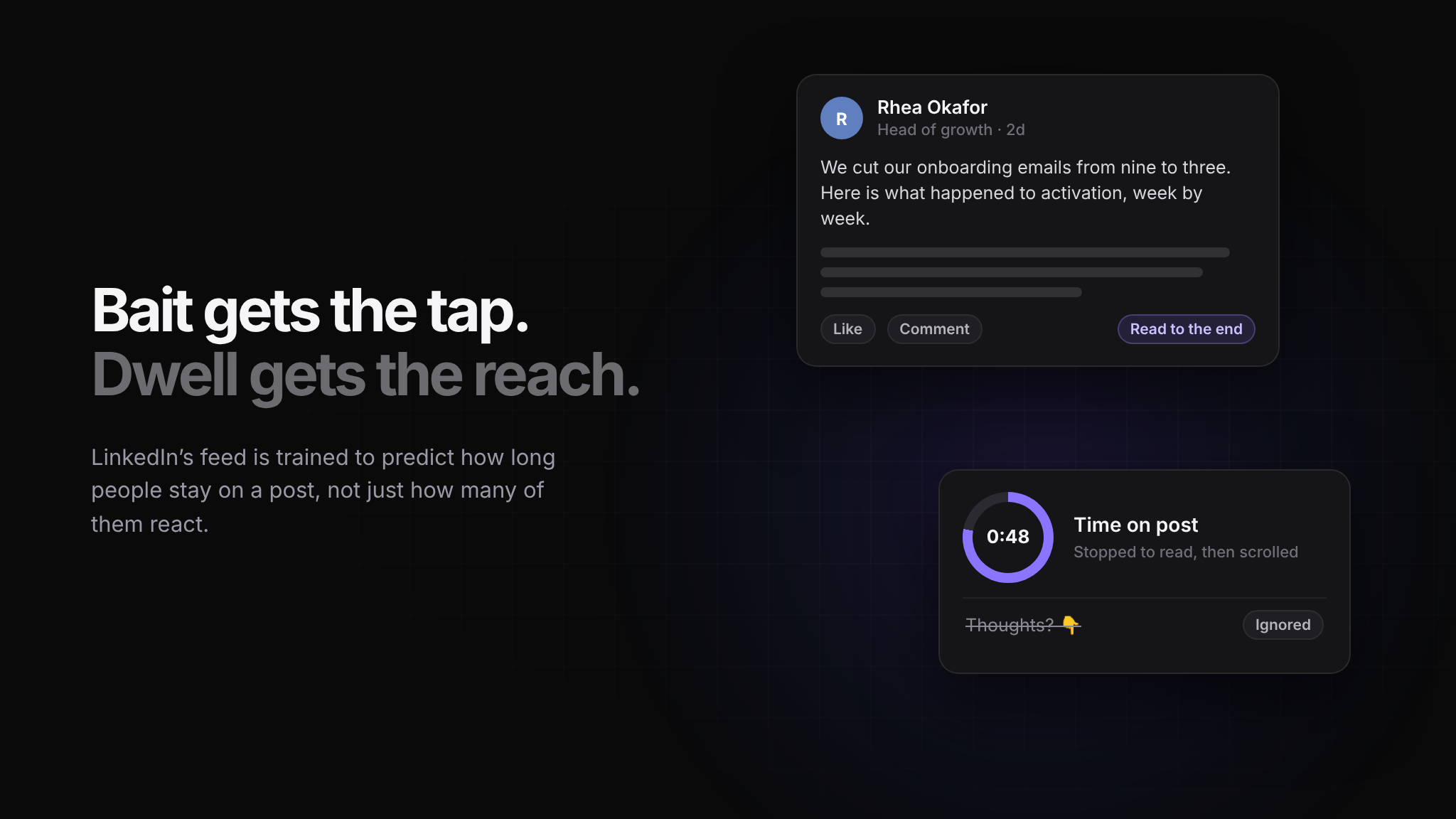
LinkedIn’s feed is trained to predict how long people stay on a post. Engagement bait buys a tap. The pause is what gets paid.
On this page
TL;DR
Bait says, “Tap if you agree.” Dwell says, “I stopped to read this.”
LinkedIn’s feed model is trained to predict how long people stay on a post, not just how many of them react.
Before you post, ask yourself: “Would a peer stop and read this to the end?”
Scroll LinkedIn for a few minutes and you will meet the same closer several times. "Thoughts?" "Agree?" "Comment YES if you've seen this too." It used to work well enough: a cheap tap, a small bump, a green arrow on the analytics screen. But the scoreboard it was built for is fading. LinkedIn is no longer paying much for noise. It is paying for the pause.
What the feed now measures
In March 2026 LinkedIn Engineering explained how its new feed ranks posts. The live system is a Generative Recommender, a sequential transformer that reads more than a thousand of your past interactions as a story rather than a spreadsheet. It predicts two kinds of outcome: passive ones, such as clicks, skips and long dwell, and active ones, such as likes, comments and shares.
Long dwell is not a blogger's invention. It is a named training target in LinkedIn's own model. LinkedIn Engineering’s earlier post, from October 2024, showed that the company judges long dwell relative to format, so 30 seconds can be long for an image and short for a video. No universal threshold in seconds has been published, which means anyone selling "hit 47 seconds or die" is making it up. Feed SR, the subject of a 2026 paper posted to arXiv, tells the same story: bucketed dwell-time features improved long-dwell prediction, and the model now serves the primary feed with a 2.1% lift in time spent.
So the feed's quiet question is not how many people tapped. It is whether anyone stayed.
Why the bait stopped paying
Engagement bait is a proxy harvest. You ask for a cheap public signal because it once stood in for value. Platforms eventually notice the proxy has been gamed and move to a signal that is harder to fake. Dwell is that signal; you cannot pod your way into someone reading paragraph three. Reactions are winks. Long dwell is a receipt.
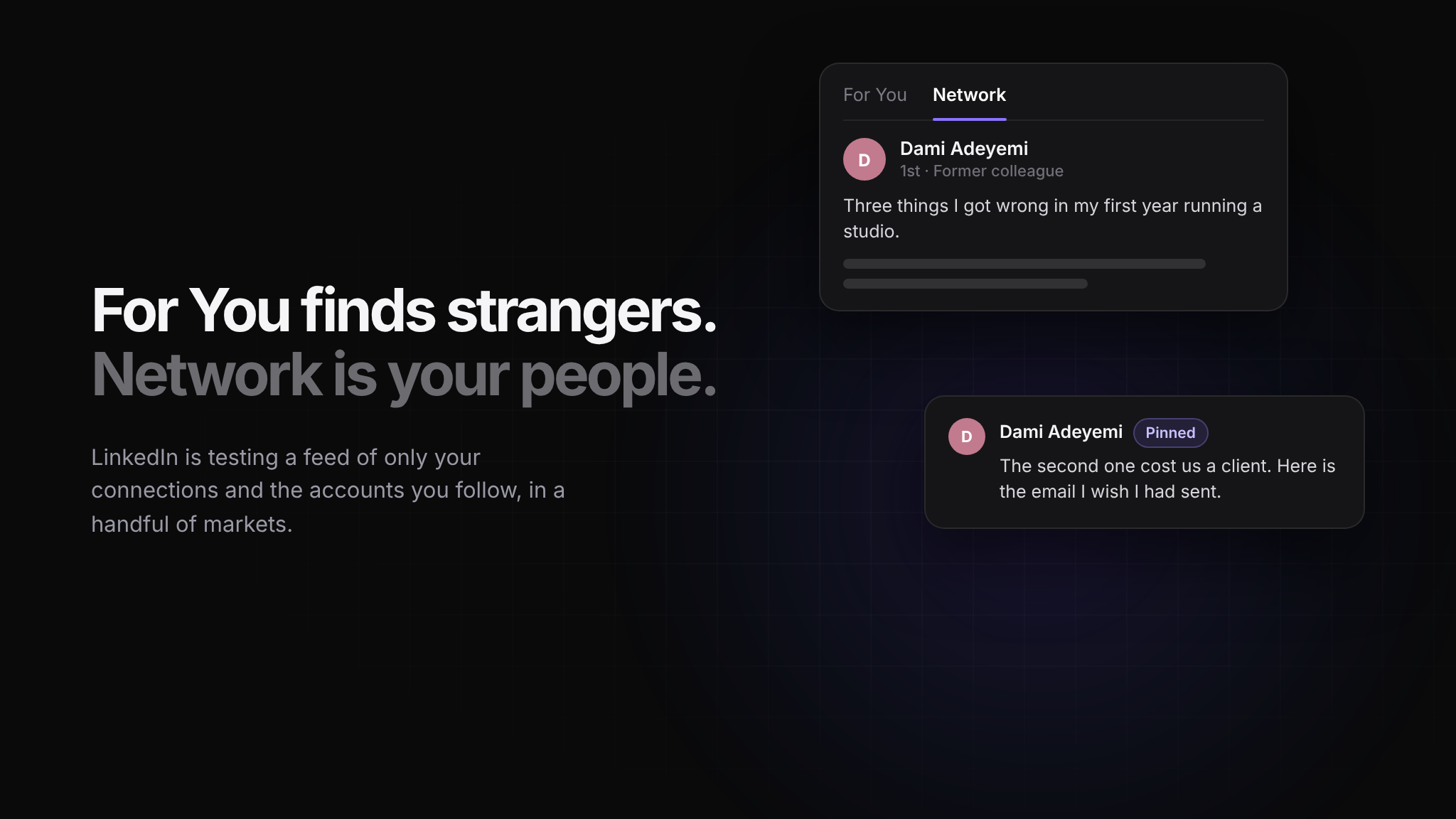
LinkedIn's product team is saying much the same. In mid-September 2026 its chief product officer, Hari Srinivasan, began testing a Network tab that shows posts only from people you have connected with or followed, promising "more real connection with real people". Discovery stays in For You; relationships get a room of their own. It is not a ranking paper, but it reads like a product confession: authenticity is the scarce resource.
None of this means dwell outranks likes by some fixed multiple. LinkedIn has not published how much each signal weighs, and figures such as "comments are worth 15 likes" have no traceable source.
Write for the hesitating thumb
The useful shift is to stop writing for the comment box and start writing for the thumb that hesitates. One concrete lesson, one specific example, one line that makes a peer think they could use it tomorrow. Often the best post is a 30-second teach: a hook, one mechanism, one example, and nothing else. End on a usable takeaway, or a precise question only a peer could answer, rather than "thoughts?". And post it from a person. The same words on a founder's or executive's profile usually earn more real dwell than they do on a company page.
Reading a post aloud before it goes out, and timing yourself, tells you a lot. If it takes under 15 seconds and contains no concrete example, add one. Then finish this sentence:
Peers will stop on this because it shows them [what].
If the blank fills itself, the post probably teaches something. If the best answer is "it asks for their opinion", you have written a poll without the data.
Over the next five posts, the more honest numbers sit past the reaction count. Note saves, comments with substance and, where you have it, read or watch time. Spend ten minutes a day in the Network tab leaving useful comments for people you actually know, rather than farming emoji in For You. The post that wins may not collect the most applause, but it will be the one people stopped to read. Pause beats pose.