The live stream is now an ad unit
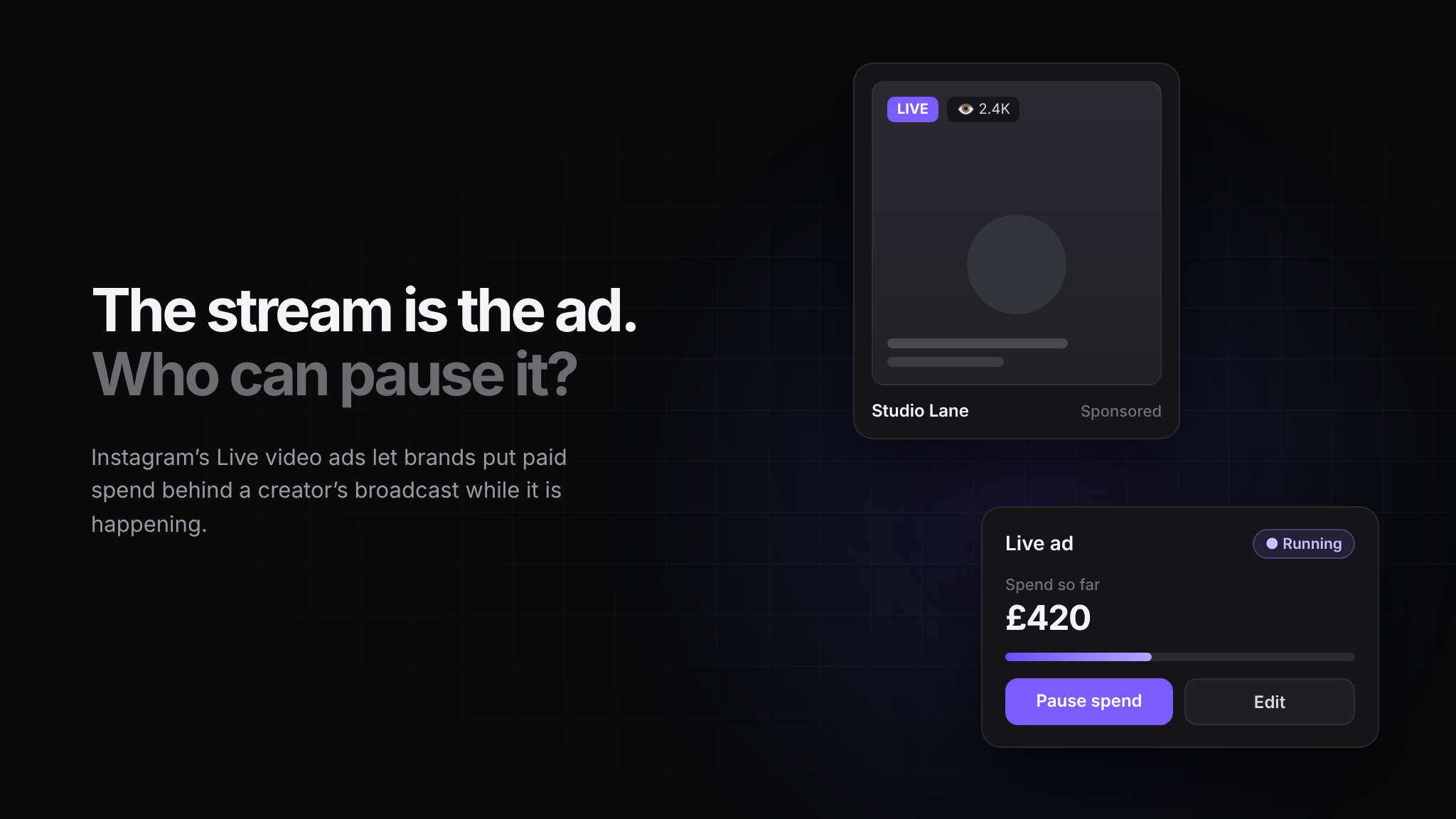
Instagram’s Live video ads let brands put paid spend behind a creator’s broadcast while it is happening. The Live is no longer theatre. It is inventory.
On this page
TL;DR
The appearance fee says, “Go live for us.” The ad budget says, “Show it to people who don’t follow you.”
Since 29 September Instagram has been rolling out Live video ads, which let brands put paid spend behind a creator’s broadcast while it is happening.
Before you book a Live, ask yourself: “Who on our side can pause the spend if it goes sideways?”
For years a brand paying for a creator's Instagram Live was paying for a room with a fixed guest list. The creator went live, some of their followers showed up, and that was the ceiling.
That changed on 29 September. Instagram's Live video ads let a brand put paid spend behind a creator's broadcast while it is happening. It runs as a Partnership Ad, shown to people who don't follow the creator. Facebook already had the format; Instagram is the expansion. The Live is no longer theatre. It is inventory.
Two purchases where there was one
Before, a brand paid an appearance fee and hoped the audience turned up. Now the appearance and the reach can be bought as separate lines. The pipe is Meta's Creator Marketing Hub, global since 15 September, which handles creator discovery (including known and predicted affiliate content), content-level permissions with expiry dates, edits that strip copyrighted music or stickers to make posts ad-ready, one-click Partnership Ads and messaging.
Why a stumble is worth paying for
Polished ads are cheap to fake, which is why audiences discount them. Live video is expensive to fake. It can stumble; someone asks an awkward question in the comments and the creator has to answer, on camera, now. That risk is the signal. Economists call it costly signalling. Customers call it "seems legit".
Live ads let a brand pay to put that signal in front of strangers. The catch is that it is also paying to amplify whatever gets said.
Priced like media, not a cameo
The brands likely to do well treat a Live as a media buy with three parts: the creator's time and audience, a usage window set as an expiring permission in the Hub rather than a vague "usage rights" clause, and an amplification budget with its own targeting. Meta's own guidance tells creators to pitch Partnership Ads as a standard add-on and to ask for more when a brand extends reach, so the ask is coming. It is better priced before it arrives.
Casting matters too. The Hub's filters surface creators already posting about a product, and they are the obvious place to start; cold-casting a Live is a good way to pay for awkward silence. And because a boosted Live turns off-the-cuff lines into the brand's advert, the brief is about claims rather than script: a few things the creator must say and a few they mustn't, such as health claims, "lowest price ever" or digs at competitors. In Britain the ASA expects ads to be obviously identifiable, a boosted Live included, so the paid-partnership label stays on and the creator says the disclosure out loud.
Then someone has to watch. The sensible arrangement is a person on the brand's side with Ads Manager open and the authority to pause spend the moment a stream goes sideways.
Built for spikes, not channels
Live is episodic. As an always-on channel it is weak; as a spike around a launch, a drop, a restock or a Q&A, it is the best room on the app. Booking "a Live" is vaguer than booking a moment.
Nor is there yet any reason to take it on trust. Meta has published no Live benchmarks, so the only numbers worth having are a brand's own: the same product and audience, a Live ad against a standard Partnership Ad for two weeks, compared on cost per acquisition and click-through. Put to a client, the pitch is not "we're paying for a Live" but "we're paying for the Live and the reach, and in two weeks we'll know whether it beats our other creator ads".
The appearance fee buys the room. The ad budget fills it.