You can now argue with the Facebook algorithm
Facebook now asks people why they tapped Not interested and lets them answer in their own words. Your audience is starting to describe your posts.
On this page
TL;DR
The old tap said, “Not this.” The new question asks, “Why not?”
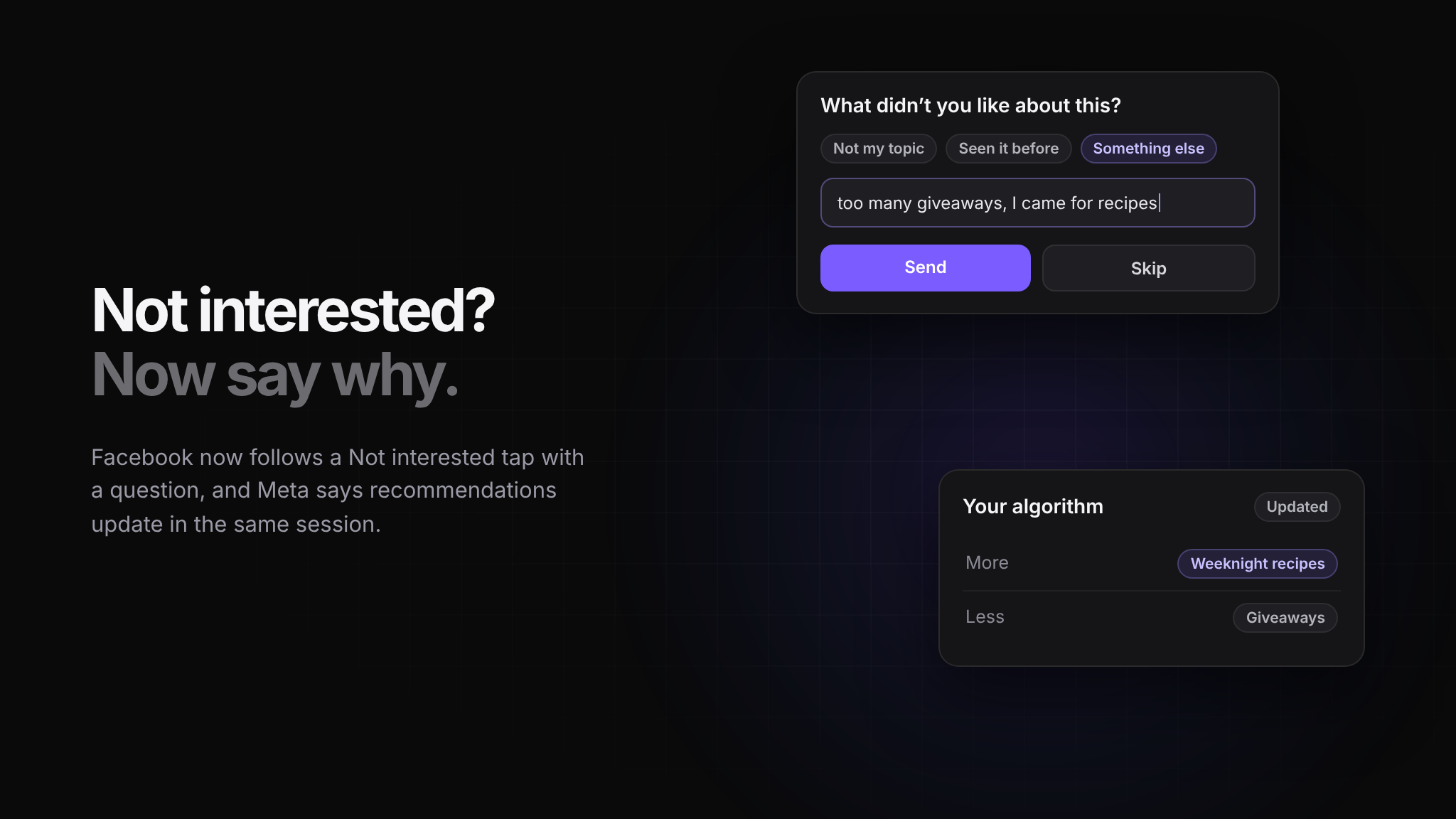
Facebook is rolling out follow-up questions after Interested or Not interested, so people can explain in their own words, and Meta says recommendations update within the same session.
Before you post, ask yourself: “Could a viewer name what this post is about in a few words?”
Tap "Not interested" on a Facebook post and, until this week, that was the end of the conversation. The app noted the tap, showed you something else and kept its theories to itself. You never had to explain, and it never knew why.
On 13 October Meta changed that. After someone taps Interested or Not interested in Feed or Reels, Facebook "may ask follow up questions for more detail on what you liked or disliked." People answer in their own words, and Meta says recommendations update in real time, within the same session. In Meta's demo, the question arrives with a few suggested answers and a box to type your own.
The tap now comes with a sentence
The update has two parts. One is a new space called Your algorithm, in the three-dot menu, where people can add and manage the topics they want to see. The other is the follow-up question. The first is a settings page, and most people do not visit settings pages. The second turns up in the feed, at the exact moment someone has decided they did not like what they saw.
That is the part worth watching. Ask someone to describe their ideal feed and they stall. Ask them what annoyed them about the post in front of them and they usually have a sentence ready.
Meta says large language models now sit inside its ranking systems to read those sentences, alongside the old signals of what people like, comment on and watch. In its words, it is "an algorithm you can actually talk to."
Your audience is now describing your posts
For years a feed has inferred what a post is about from what it contains and who engages with it. Now some viewers will simply say. And they will say it in their words, not yours.
Picture a gym page that posts a bit of everything: a deadlift tip, a member's birthday, a meal-prep Reel, a 20% off code. One viewer who followed for the lifting taps Not interested on the meal prep and writes "less diet stuff". Meta has not said how much weight that sentence carries, whether it touches anything beyond that one person's feed, or whether Pages will ever see what people wrote. But for that viewer the page has just been described, and the description is narrower than the page thinks.
The posts most at risk are the ones that are hard to describe. Think of the Reel that only makes sense after the caption, the promo dressed up as a meme, the trend borrowed from someone else's niche. The viewer cannot say what it was, so they say what it was not.
Write the first line they would type
The useful habit is to make every post easy to name. Say the topic in the first line and show it in the first frame, in the words a viewer would use to ask for more of it. "How to stop your back rounding on deadlifts" is something a person might type into Your algorithm. "Monday motivation" is not.
Keep the main thing main. Side topics are fine, but if every third post wanders, the people who came for the core will start telling Facebook so. Your comments and DMs are a free glossary: the phrases people already use to describe you are probably the phrases they will type.
If the feature has reached your account, open Your algorithm and type your own niche the way a fan would. What Facebook serves back is roughly the company you are competing with for that viewer's attention.
The feed has started asking
Facebook is not first. Instagram brought Your algorithm to Reels last December and widened it to Feed and Explore in June, and Threads has its own version called Dear Algo. What is new here is the follow-up question, and that it now lives on Facebook itself.
Meta gave no markets, no dates and no numbers, so it would be a mistake to plan around a reach change nobody has measured. The direction is plain enough, though. The feed used to watch what people did. Now it also asks what they meant, which makes a post that is easy to explain worth more than one that is merely easy to scroll past.
Sources
Social Media Today: Facebook adds plain language algorithm controls (13 Oct 2026)
TechCrunch: Facebook is giving users more control over their algorithm (13 Oct 2026)
The Verge: Facebook will let you customize your feed algorithm using AI (13 Oct 2026)
PPC Land: Facebook feed now takes typed requests as Meta adds LLMs to ranking (13 Oct 2026)
NBK Social: Facebook lets people tell its Feed and Reels algorithm what they want (14 Oct 2026)